
Where Do New Ideas About What is Good Come From?
July 31, 2026
This essay is about moral imagination as a design practice, including my own unresolved confrontation with one of its results. Posted to both my Substack and my notebook – comments are open at both, and I'd love to hear your thoughts!
And what is good, Phaedrus, And what is not good – Need we ask anyone to tell us these things? – Robert Pirsig, inspired by Plato
One of my favourite places is the St. Gregory of Nyssa Episcopal Church, in the Potrero Hill neighbourhood of San Francisco. It's unassuming from the outside. You enter to see a dome ringed with shining life-size saints, all dancing. If you look closely, you realize these are not the usual Christian saints. You see Rumi, Mohandas Gandhi, Anne Frank, Charles Darwin, Paul Erdős, and more, a generous, expansive notion of sainthood:

The Church is named for a bishop of the long-vanished town of Nyssa, in what is now Turkey. In his own time, Gregory was a small-town bishop, peripheral to affairs of the Church. He wrote several books, but they became well known only long after his death. In 379 CE he delivered a homily on Ecclesiastes that contains the first known unequivocal condemnation of slavery. Gregory argued that since human beings are made in God's image, to enslave another person is to set oneself above God. In Gregory's words:
If [humanity] is in the likeness of God, … who is his buyer, tell me? Who is his seller? To God alone belongs this power; or rather, not even to God himself. […] God would not therefore reduce the human race to slavery, since [God] himself, when we had been enslaved to sin, spontaneously recalled us to freedom. But if God does not enslave what is free, who is he that sets his own power above God's?
Today, such a condemnation is unsurprising. We know slavery is bad. But in Gregory's time it was an almost unthinkable idea. As far back as we have records, slavery is present in every large civilization, from China to Mesopotamia to Rome. There is no problem with slavery in the Indian Vedas, in the Chinese Analects, or in the Greek Philosophers. Nor in the Christian Bible, where slaves appear often, and slaveholding is sometimes depicted positively. A person could own another person. St. Paul comes close to showing discomfort: in his letter to Philemon he returns a runaway slave, but asks that the man be received "no longer as a slave but as a brother." But even Paul does not take the step of condemning slavery itself.
Then Gregory, in 379 CE, steps outside the ideas and institutions of his society, and condemns slavery entire. Countless people have been slaves, their lives owned by another. Gregory had the moral imagination to realize this was unequivocally wrong.
Unfortunately, he was almost entirely ignored. The idea was perhaps too strange, too upsetting to the order of things. It didn't launch a movement or change church teaching. St. Augustine, a generation later and far more influential, continued to treat slavery as a consequence of sin, part of the divine order, not something to fight against. The world had to wait 1,200 or so more years for the idea to be rediscovered and then slowly enacted1.
Moral imagination shapes and reshapes humanity. More than 2,000 years before Gregory, Hammurabi ruled Babylon, near the Euphrates River in modern Iraq. Today, Hammurabi is best known for his law code, one of the progenitors of modern justice systems. The code may be seen in the Louvre Museum in Paris, carved into a stone pillar over two meters tall and weighing four tonnes. At the top of the pillar Hammurabi is shown receiving a rod and ring – signifying the authority to measure and judge others – from Shamash, the sun god of Babylon. Below, the pillar contains the text of the law code – 282 provisions, ranging from how to treat a murderer to what to do if someone floods a neighbour's granary. The provisions are too small to see in this image, but up close they blanket the pillar.
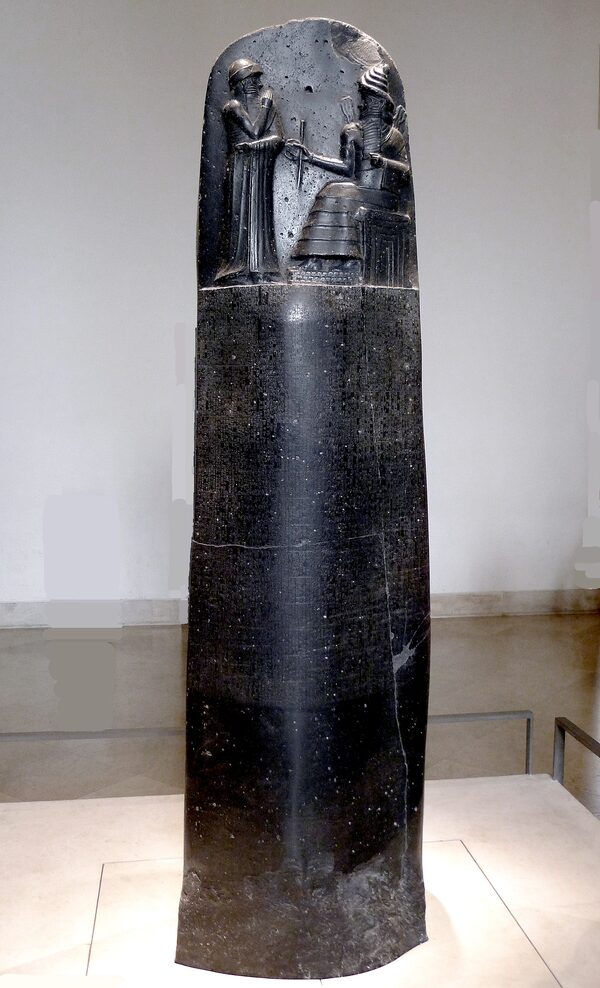
In the prologue to the law code we are told the gods have called Hammurabi forth "to cause justice to prevail in the land, to destroy the wicked and the evil, that the strong might not oppress the weak." The epilogue repeats this last phrase, and expands on it: "that the strong might not oppress the weak, and that even the orphan and the widow might be treated with justice… let the oppressed person stand before my monument and have the words read aloud, so that person's mind can rest easy that justice will be done."
This is a striking argument. Hammurabi is not justifying his rule by birth to the previous king. Nor by being himself a god. Nor even by military conquests or by good governance. No: Hammurabi's power is justified by the service he does for the weak, protecting them from the strong. The idea was not entirely new – 600 years earlier, King Urukagina of Lagash had justified his rule on the grounds that "the orphan and the widow would not be delivered up to the powerful man", and other later rulers had used similar ideas. But Hammurabi gave it its most forceful statement yet.
It is tempting to be cynical, to assume Hammurabi was merely trying to win people over. Perhaps – though currying favour with the powerful seems a better strategy. But even on a cynical read, the idea is remarkable. Like Gregory's homily, this is an act of moral imagination, improving our notion of good action in the world. Variants of the idea echo through the Christian Bible, and we hear it still today, when powerful organizations argue for legitimacy by claiming to serve everyone, not merely the wealthy.
I believe that there is one story in the world, and only one… All novels, all poetry, are built on the never-ending contest in ourselves of good and evil. – John Steinbeck, East of Eden
There is nothing inevitable about human notions of good behaviour. When a sand tiger shark is pregnant, the strongest embryo eats its siblings in the womb. In some spider species, the mother's body breaks down after giving birth; her children then swarm and devour her alive, her body their final meal, a strange gift of motherly love. Female ichneumon wasps lay their eggs inside a living caterpillar. When the eggs hatch, the larvae eat their host from the inside – fat and digestive organs first, heart and nervous system last – so the caterpillar stays alive and fresh as it is devoured. Only when the larvae are ready to pupate does it finally die. All this is natural, part of the life cycle of these species.
Yet if the behaviour of some species is foreign to us, much in other species is familiar. Elephants sometimes protect and may even grieve a person who has done them a kindness; a pod of dolphins will nurse an injured member to the surface to breathe; lions may play with cubs with startling gentleness and patience. This familiarity is not surprising, since many of the underlying biological processes are also present in human beings.
But although we may recognize much of ourselves in such examples, we are also different. We have a capacity for moral imagination, an ability to develop and transmit new notions of good action, indeed, even new kinds of good. Such moral imagination belongs to human beings alone2. We can be moral pioneers.
Many of my heroes are moral pioneers. People like St. Gregory, Jesus, and Gandhi discovered new types of moral action, new ways of doing good in the world. I say "discovered", but there are two issues with that word. The first is whether it's really a discovery of something pre-existing, latent in the cosmos, or if it's a more contingent invention. Discussing this is a topic for a future essay3 – we'll use "discovery" for now. The second issue is that "discovery" seems to imply a discrete advance attributable to a person. But moral discovery is often a process extended over many people and cultures, not a single step.
For example, prior to Gregory, manumission was often viewed as good for the slave freed; but that's not the same as being viewed as an intrinsic good. Seneca argued that slaves were fellow human beings deserving humane treatment, but didn't question the institution itself. Such ideas prepared the way for Gregory's argument, but did not anticipate its full force. And getting from Gregory to the modern understanding required more: for instance, the gradual closing off of exceptions – captives of war, debtors, those of a different skin colour or religion. Then more work still to make it real: the Emancipation Proclamation, the end of Jim Crow, and so on. A good history of moral imagination would trace all this; my intent is only to gesture at it. When I credit an individual like Gregory, I'm using shorthand for their contribution to that larger story.
What we explore in this essay is more basic: how does a moral pioneer like St. Gregory develop new types of good action? It's moral imagination as a design practice, expanding the extant good into the larger space of possible good:
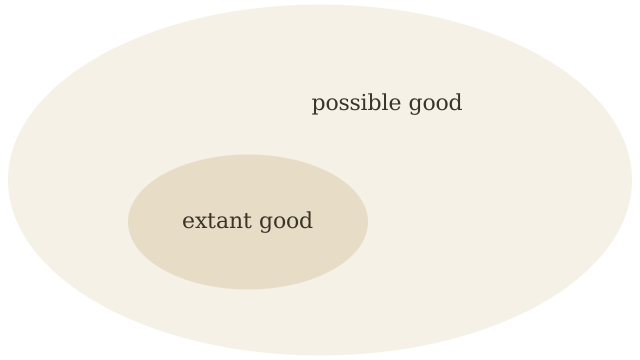
This expansion4 is about developing new possibilities for action, new values, new moral arguments, and new standards of judgement. At its most fundamental, it yields new moral primitives. Gregory did not select the right view of slavery from the views available in 379 CE. He found a novel view of human beings, and once found, that became a primitive others could build on, with an expanding frontier of the good opening up behind it. Or consider an idea like "turn the other cheek", from the Gospels. Before someone conceived it, it was not an option that people merely declined to take. Rather, it lay outside the space of imaginable responses to injury, from vengeance to grudging restraint to doormat acquiescence. Turn the other cheek was not a move within that game; it was a new moral primitive out of which moral life may be built. Once discovered such moral primitives often seem so basic it is hard to believe someone had to conceive them. Yet they enable new means of co-operating with one another. We see this vividly today: modern political order rests in part on the claim that persons cannot be property; entire traditions rest on "turn the other cheek."
The moral imagination viewpoint contrasts with a picture in which our goal is choosing the best possible action from an existing menu. Choose the right charity to donate to, the right career, the right cause. This is a common everyday view, with Effective Altruism an especially well-developed instance, often concentrating on choosing between existing ways of doing good – is it better to donate a dollar to cause A, B, C, or D, on the GiveWell list of recommended charities? That is a valuable project. But the intellectual focus is on selection from the existing menu, which fundamentally underrates imagination5. When we can expand what it means to be good, contribution may lie not only in selection but in imagination — a fundamental virtue, expanding the range of good actions available to be selected from. I find myself tantalized (and sometimes worried) by this: what notions of good have we not yet imagined? What will we one day judge as evil that today we do not? Or, more optimistically, as a lesser good that we may greatly improve upon?
While I find St. Gregory of Nyssa and Hammurabi striking as examples of moral imagination, this essay originated elsewhere, in my reading of the Gospels around 2020 or so. I hadn't read them since childhood, and was repeatedly shocked by ideas that could only have come from a moral genius. You may or may not agree with "Love thy neighbour as thyself" or "Blessed are the meek, for they shall inherit the Earth", but they are certainly powerful ideas, forcefully articulated. While the Gospels didn't invent kindness or forgiveness or compassion – we see similar behaviour in other animals – they helped reinvent them in radical, imaginative ways, changing our notion of good not only in Christianity, but around the world6.
I wrote this essay primarily for myself. I wanted to better understand the heuristics of moral imagination. This was in part for the reason already stated – moral imagination can transform our relationship to one another and to the cosmos. I also had an instinctive sense it's connected to how we find purpose and live meaningful lives; as Steinbeck suggests, the story of good and evil is central to how we understand our lives. New types of good (and evil!) create new types of ought, and thus new goals for heroes (and villains), and so new kinds of story and meaning.
While writing the essay I worried about my ignorance of academic moral philosophy. It is a specialist subject with a vast literature, which I've only slowly been engaging with. (It is also a subject matter of intrinsic interest to every human alive: we are all vernacular moral philosophers.) I have reservations about going too deeply into the academic subject7 – I want to metabolize its best insights, without being snared by its assumptions and working style. In particular, I'm not arguing here for any position on moral realism, whether moral facts are real. And while I informally use the language of moral progress, depicting some discoveries as "good" or "evil", I've only done so in cases where that is uncontroversially settled – moral imagination is about how new moral ideas are made, not their ultimate status. I've learned much from moral philosophers, especially Philip Kitcher, Charles Taylor, Alasdair MacIntyre, and Bernard Williams. But I've also tried to pursue lines of thought – notably, the imaginative design view, and immersion in particular examples and enaction – outside the mainline of moral philosophy. Even so, I expect some of what I have to say has been said before, and better. Still, I wanted to set it down in order to develop my own point of view. My apologies to moral philosophers.
I also wrote the essay as preparation for a future essay, on how we develop notions of success. What does it mean to be successful? To what should we aspire – and how ought we form aspirational goals at all? For a society to be healthy its prevailing notions of success ought to overlap substantially with what is good; a society which valorizes bad people will be dysfunctional. How can we choose good heroes? And how can we best tell the stories of good (and bad) people, in order to inspire a spirit of emulation?
I struggled writing this essay. Even vernacular moral philosophy is a dangerous pastime. I used to find amusing the experiments suggesting that philosophers of ethics may show no better ethical behaviour than other people8. Now I think that's to be an expected outcome of making moral standards an object of study – in so doing you place yourself in part outside those standards. There is also the danger of self-righteousness, a belief you know better than others. It's a terrible affliction, and it's one this kind of reflection encourages. As the scientist Richard Feynman once wrote9: "I'm getting moraller and moraller as I get older – that's bad." If you must make harsh judgements, make them preferably of yourself; be generous with others. But you must also be (mostly) compassionate in judgement of yourself! Some humility and humour is necessary for an endeavour like this one to be successful; so too enacting the ideas in the world, even in small ways. Reflective enaction is the way to deeply understand moral ideas, not by analysing or even discovering them.
Unfortunately, we can't talk with Gregory of Nyssa to understand how he arrived at his ideas. But there are moral pioneers closer to our time whose stories we can understand in more detail. In 1998, an American nurse named Joyce Roush attended a conference where she heard about a new approach to kidney donation10. Up to that point, kidney transplant surgery was difficult, usually involving breaking a donor's rib, and a long recovery time. But this new procedure made it easier and less arduous. She approached the surgeon who'd pioneered the procedure, Lloyd Ratner, and told him she'd like to donate a kidney. This surprised Ratner. He'd met many donors, but invariably they were donating for a friend or family member. Roush wanted to donate purely altruistically, for a stranger. Eighteen months later, in September 1999, she underwent the surgery at Johns Hopkins in Baltimore. Within hours, her kidney was transplanted into 13-year-old Christopher Bieniek, a Maryland boy who had been in kidney failure, on dialysis every night. Three days after the operation the two met for the first time. Soon after she left the hospital to recover at home, reporting feeling "a little tired, a little sore", but also curious about how the recipient would use the gift of his donated kidney.
Roush was not the only person to make this moral discovery. In the 1990s, a wealthy businessman named Zell Kravinsky began donating millions of dollars to support public health11. As he increased his philanthropic giving, he wondered what more he could do. Early in 2003 he read an article in the Wall Street Journal, and learned that the odds of a kidney donor dying from the transplant procedure was about 1 in 4,000. After the transplant, most donors continue to live well with just one kidney, apparently near unaffected, while the transplant transformed the recipient's life. In his own leap of moral imagination, Kravinsky decided to donate a kidney altruistically to a stranger, on the grounds that: "to withhold a kidney from someone who would otherwise die means valuing one's own life at 4,000 times that of a stranger".
Roush and Kravinsky were pioneers of a new kind of moral act: purely altruistic kidney donation. (I will use the term "altruistic kidney donation" to mean a donation not directed toward any particular person, though of course any donation may be altruistic.) They were not, however, the first to think of or do altruistic donations. Roush was preceded by at least one other anonymous donor in the US12, about a month before her own donation. And people had considered altruistic donation to a stranger much earlier, all the way back in the late 1950s, soon after the first successful kidney donations. But for a long time such donations were not done, at first because of immune rejection if donor and recipient weren't close relatives, and later due to the burden on donors. According to a 1971 paper in Seminars in Psychiatry13, the idea was viewed as "impulsive, suspect, and repugnant." After Roush's altruistic donation was publicised, it kicked off a wave of people volunteering – more than 50 people called Johns Hopkins to volunteer – and by the time Kravinsky made his donation, he was the 134'th person in the US to make a donation not directed to any specific person.
But although Roush and Kravinsky were not literally the first altruistic kidney donors, both were part of the moral discovery. Roush by independent discovery of the act, by being one of the first to enact it, and by doing so publicly. And Kravinsky, by developing and publicising a new moral argument explaining and justifying the act – his 1-in-4,000 argument, which drew on a talent for mathematical reasoning applied to everyday life, honed in real estate, and on his drive to do as much philanthropic good as possible.
Is altruistic kidney donation actually a good thing to do? While many people find altruistic donation admirable, others object. Some people consider Roush and Kravinsky's act a form of disconnection from their loved ones, or even alienation from their selves. And some people strongly disagree with (or find inadequate) Kravinsky's 1-in-4,000 argument. Roush's husband said that when he first learned of her intention to donate a kidney: "That very definitely had a profound effect on me, gave me a lump in my throat and made me feel ill. It caught me off guard. I have adapted to the idea since then."
Kravinsky's wife went further. She was so set against the donation that he did much of the work toward it in secret. He "snuck out" to the hospital for the operation, but after the operation developed some complications, and called his wife to ask for help. Kravinsky reports: "She was furious. She didn't want me to die, but, on the other hand, she was beyond human rage." After visiting him in hospital, Kravinsky's mother recalled: "I was so filled with anger that I didn't speak." He came close to divorce, and the donation affected his relationships not only with family but also with friends.
Of course, this angry response is not universal. Many people find altruistic donation admirable. Roush, Kravinsky and other altruistic donors have received considerable attention in the media, often (though not always) positive. Roush in particular has received many awards, including being asked to carry the torch for the Winter Olympics in 2002. And altruistic kidney donation has developed into a movement, with more than a dozen organizations formed to encourage and enable people to make altruistic kidney donations. As I write, several thousand kidneys have been altruistically donated worldwide. Clearly, many people find this worthwhile.
So there is genuine disagreement about whether this is a good or bad act: moral discoveries take time for humanity to fully metabolize. Regardless, altruistic kidney donation is an example of moral imagination; it has expanded our moral universe. And that initial spark of moral imagination has resulted in a new, repeatable, scalable form of altruistic giving. It's tempting to conclude that the number of altruistic donations made is small enough that this doesn't meaningfully change society as a whole. But moral discoveries also often grow gradually in importance. The abolitionist movement started small, and remained so for a long time. But the moral discussion it instigated mattered. And we may have a similar discussion today: is altruistic kidney donation the right thing to do? Do we have an imperative to do it? Or is it a mistake? How should we think about it? As consensus develops around these and concomitant questions, moral discoveries have the potential to change human civilization.
At an individual level, the act poses a moral quandary to all of us. Suppose you have two good kidneys. Do you have a duty to donate one yourself? Friends of mine have done it, apparently with no ill effects. They've cited arguments similar to Kravinsky's. But I haven't done it myself. It's not that I have a good argument against it. Rather, I've largely refused to think much about it, a contented equilibrium I've disrupted by writing this essay.
Of course, it's easy to make up arguments against making a donation. I worry about complications, no matter the 1-in-4,000 argument. I suffer a mild auto-immune condition, which mostly causes me few problems, but it is treated in part by anti-inflammatory drugs which can be hard on kidneys. I take special care of my kidneys as a result, and fear disrupting that.
I'd like to think this is a good faith argument. But I know myself well enough to admit: it's in part rationalization. It's hard to determine whether I'm making the argument because I fear the donation, or fear the donation because of the argument.
In a similar vein, I've seen Roush's 2011 talk about her donation, given at TEDxAsheville. I didn't much like the talk. I find myself repelled by her – noticing times she pauses for applause (to solicit applause, in my imagining), little vanities. But I wonder: am I looking for reasons to disapprove? I suspect I am. If I don't like her, then it's easier to reject her example.
I'm frankly scared to donate a kidney. Selfishly, I would resent it. There is a visceral revulsion, imagining someone opening my body up and removing a part of me. And yet: somewhere in the world there is a person on dialysis, with little time left to live, whose life I could choose to massively improve, likely at relatively little cost to myself or my loved ones. I can make the world much better. And I am choosing not to.
Probably you are too.
A friend asked Kravinsky: "Do you mean that anybody who is not donating a kidney is taking someone’s life?" When Kravinsky replied "yes", he asked: "So, by your terms, I'm a murderer?" I disagree with Kravinsky when he again replied "yes". And yet the obvious disagreement is a cheap semantic dismissal, arguing he's using the term "murderer" wrongly. It avoids the genuine underlying issue: am I doing wrong in not donating a kidney?
Moral imagination does not only apply to good acts. People sometimes conceive novel ways of doing evil. Hannah Arendt argued that the Nazi genocide was appalling not just on account of the killing, but also because the Nazis invented a new type of crime, one going beyond murder or even mass murder, a crime that aimed at something qualitatively different: destroying an entire people14. One may question the history; there were precedents for genocide in Armenia, Namibia, and the Caucasus, among others. But her underlying point is insightful15:
It is in the very nature of things human that every act that has once made its appearance and has been recorded in the history of mankind stays with mankind as a potentiality long after its actuality has become a thing of the past. No punishment has ever possessed enough power of deterrence to prevent the commission of crimes. On the contrary, whatever the punishment, once a specific crime has appeared for the first time, its reappearance is more likely than its initial emergence could ever have been…. It is essentially for this reason: that the unprecedented, once it has appeared, may become a precedent for the future.
The Nazi genocide was a horrific example of moral imagination. But the pattern Arendt describes doesn't depend on whether an act is good or evil. Once a new kind of act has been conceived, or a new justification articulated, it becomes far easier for others to repeat – and this is as true of Roush's and Kravinsky's donations as of the crime Arendt has in mind. We see it also in the repeated use of variants of Hammurabi's justification for power. Gregory's condemnation of slavery is an exception, perhaps because it lay so far outside the standards of its day that it had to lie fallow for more than twelve centuries. But her point for the most part stands.
Genocide is an extreme example of the discovery of a new type of evil. But many evil acts began as moral discoveries. Even a practice as formerly ubiquitous as slavery must have originated somewhere, in the depths of pre-history. While some of our primate relatives have strong dominance hierarchies, none so far as I know has developed a notion of owning other primates16. It is we humans who developed that idea. It was developed in stages, and we have historical records for some of those stages. In an infamous discussion in his Politics, Aristotle justified slavery on the grounds that some people are by nature slaves:
He who is by nature not his own but another's man, is by nature a slave… the lower sort are by nature slaves, and it is better for them as for all inferiors that they should be under the rule of a master.
He elaborated at length on this theme, another appalling example of moral pioneering, plausibly doing immense damage to the lives of millions of people. Moral imagination and moral discovery are dual-edged. They expand the way we humans act, sometimes for the good, and sometimes in terrible ways.
How does one do moral discovery? Where do new moral ideas come from? In this section we explore a few heuristics for moral discovery. I'm dissatisfied with the exploration, but we'll at least get some purchase on the problem, and identify some questions for future exploration.
One heuristic for moral imagination arises from examination of historical cases: get into sustained, intimate, varied contact with a moral problem. This was true of Mary Wollstonecraft, Mohandas Gandhi, Martin Luther King, and many other moral pioneers. Professionally, Joyce Roush's job was to talk with the families of people who had just died, asking whether the family would allow organ donation; she had been present for more than a thousand deaths17.
In a similar way, years before writing his anti-slavery homily, Gregory's beloved older sister Macrina persuaded their mother and her household to give up aristocratic rank and live with their servants and slaves, eating their food, sharing their work, and treating them as equals. We don't know how or why Macrina had this idea – she left no writing herself – but clearly Gregory was immersed in a world in which slavery was a live, intimate problem, and people close to him were thinking deeply about it18. Like Gregory, Macrina was later canonized a saint.
Often this contact with a moral problem is involuntary. Wollstonecraft, Gandhi, and King all became acquainted through accidents of birth. But sometimes contact with a moral problem is actively chosen. Simone Weil left a job teaching philosophy to do unskilled work on factory assembly lines, believing you could only understand certain kinds of affliction and destruction of self from the inside. That experience was at the core of her later writing. Whereas most of us find moral problems aversive, and try to limit their impact, Weil moved toward them. And while Wollstonecraft, Gandhi, and King may have been born into the problems they confronted, each chose to turn toward them, rather than to limit their impact. I'm suspicious of this tendency in myself: I don't know where to set the boundary between what to engage with and what to leave aside19.
Such intimacy with a problem is not a mere abstract or passing acquaintance. It is knowing the many ways a problem expresses itself; the partial measures that ameliorate it; the ways promising remedies go wrong. That detailed knowledge helps form a moral pioneer's imaginative response, and brings real emotional force to the response.
This heuristic seems obvious, but it contrasts with the tempting view that moral imagination comes from highbrow moral philosophizing based on grand theories. Sometimes such theories contribute; but more often moral imagination comes from immersion in particular problems and contexts. The cosmos is far richer than any of our theories, and immersion in a detailed problem gives you more to work with than can be deduced from first principles. That's not to dismiss existing knowledge – much of moral life can, of course, be reduced to familiar cases and settled standards, with no need to discover anything. But new ideas arise where existing standards don't address the situation and something new is needed. Feyerabend argued much the same about science, that there is no scientific method20. There is likewise no "method" for moral design, no "logic of moral discovery". But there are many useful heuristics.
A second heuristic for moral imagination is to find and explore moral problems which seem strange or unfamiliar. In this I am echoing the physicist John Wheeler who once gave advice that applies to moral as well as scientific imagination: "In any field, find the strangest thing and then explore it." Strangeness often signals that existing moral ideas are insufficient to understand a situation, and new ideas are needed.
We see this heuristic at work in the case of altruistic kidney donation, where a new technological possibility eventually gave rise to new moral ideas. A similar pattern may be seen in the histories of many areas which have seen recent ferment: in changing childbirth (e.g., in vitro fertilization, embryo selection, and prenatal testing – the origin of the phrase "moral pioneer"21), or in changed meanings for personal identity (e.g., gender transition surgery, plastic surgery).
Today we are seeing many new moral problems arise as the world moves through the early stages of what may be a transition to trans- and posthumanity: are AIs moral subjects; are they a threat to humanity; what problems will advances in human longevity and cryonics and brain-computer interfaces give rise to? Anyone who has seriously engaged with any of these questions knows one quickly gets to very strange and unfamiliar places.
These two heuristics overlap with the viewpoint of the philosopher Philip Kitcher in his book The Ethical Project. In Kitcher's view, new moral ideas often come as a way of addressing ongoing problems within communities. Such discoveries are then embedded in institutions, and improved and transmitted through culture – sometimes literally carved in stone, as for Hammurabi's law code. Different communities will thrive more or less well due to the quality of those ideas, and that in turn will affect the spread of those ideas to other communities. It's cultural selection and amplification determined in part by the quality of moral ideas. This does not mean that "what is good" is simply determined by the success of an idea in spreading this way. But clearly some moral ideas are more useful than others for helping communities thrive.
These solutions necessarily arise in part out of existing moral frameworks. Gregory didn't make the modern anti-slavery argument. Indeed, today many would find Gregory's argument thin, resting as it does on a particular reading of Christian scripture. But of course he used the ethical standards of his time to identify and understand a moral problem, ultimately going beyond those standards. His argument helped prepare the way for the modern understanding, without actually being a modern understanding. Today we believe his conclusion on other grounds – for instance, if you accept the value of individual freedom and equality, then abolitionism follows immediately. (The early history of the United States is in part a desperate attempt to evade this conclusion.) There's a bouncing back-and-forth: Gregory took certain moral arguments seriously, arrived at a new conclusion; later thinkers took the conclusion seriously, and found new moral primitives and arguments leading to closely related conclusions. This violates how many think about rational argument, but seems common in moral discovery: we don't merely argue from standards to conclusions, but rather there is a more complex back and forth. I'd like to understand this more deeply22.
One frequent source of strange and unfamiliar moral problems is new technology. Such technologies may, for example, change the distribution of power (e.g., the atomic bomb, the internet and social media), change the ability to access basic needs (food and shelter technologies), or the nature of labour (electricity and motors). Technology changes very basic aspects of the human experience, so it's unsurprising it gives rise to moral problems without solution in existing frameworks.
A good detailed example of this pattern is altruistic kidney donation. The first successful kidney transplant was between two identical twins in 1954. But transplants took time to become commonplace, since they usually caused an immune rejection of the new organ, unless donors were closely related. In the 1960s immune-suppressing drugs began making it easier to do transplants between unrelated people. This increased the number of kidney donations, especially after a very effective new immune-suppressing drug called ciclosporin was approved in the 1980s. The number increased again after Ratner and his colleagues developed their simplified procedure in the 1990s. But as Ratner's surprise at Roush's request attests, altruistic kidney donation required moral imagination beyond the technology itself, a kind of moral imagination that continued with Kravinsky and with later debate over the status of the act. The meaning of a newly possible act is not intrinsic to the technology that enabled it; much of it lies in the stories we tell about the act.
Science and technology are the interface between human intention and the cosmos. New technologies can expand the range of actions available to us, and so give us new possibilities to form intention. In particular, science and technology can make abundant that which was formerly scarce or impossible23. This makes it easier for us to meet our own desires; it also creates new desires; and may make it easier or harder for us to impose our will on one another. This transforms old moral problems, and creates new moral problems. Often it makes problems of fairness go away – consider the way food and shelter technologies have given many more people adequate food and shelter. But it can also change the balance of power, sometimes making things fairer (abolition, civil rights, feminism) or less fair (colonialism, imperialism, and many wars).
Let me sum up this discussion in a list of three heuristics underlying moral imagination and moral discovery:
Of course, these are just a few of the heuristics used in moral discovery. Let me briefly mention four more. These are more commonly discussed, and so I've less to say about them, but they seem useful to mention as part of my incomplete sketch toward an imaginative design practice. Perhaps in some future essay I'll have more to say about these.
I've discussed something of how moral discovery takes place. But I have said little of what it feels like from the inside. Did Mary Wollstonecraft have a sense of revelation as she developed her arguments? Did Gregory of Nyssa? Some sense of a magical discovery? Or was it a slower dawning of understanding? James Watson, one of the discoverers of the structure of DNA, gave a manuscript of his book The Double Helix to Richard Feynman. Feynman read the book, and wrote to Watson25:
Don't let anybody criticize that book who hasn’t read it through to the end. Its apparent minor faults and petty gossipy incidents fall into place as deeply meaningful…. The people who say “that is not how science is done” are wrong…. When you describe what went on in your head as the truth haltingly staggers upon you and passes on, finally fully recognized, you are describing how science is done. I know, for I have had the same beautiful and frightening experience.
I wrote this essay as the first preparatory draft for a chapter in a book. I hope the second draft will deserve a stronger subtitle: "What is it like to invent a new kind of good?" This first draft doesn't deliver on that – despite the heuristics, we haven't gotten deeply inside what it is like to be a moral pioneer. The closest is perhaps my refusal to donate a kidney, which at least gets inside a confrontation with a moral problem, even if the ultimate result is a refusal. A second draft must go deeper! I believe moral discovery is, like scientific discovery, often also a "beautiful and frightening experience". Not so much a clear moral triumph as a gradual and uncertain dawning of insight, out of muddle and doubt and confusion, with certainty and understanding only being found after the fact. And yet it is out of such discovery that meaning and the good and much of human progress arise.
Obviously, these views were formed in conversation with and through the example of many people. But I am especially grateful to Fawaz Al-Matrouk, Mona Alsubaei, Alexander Berger, Laura Deming, Tim Hwang, Henrik Karlsson, Rob Long, Andy Matuschak, Catherine Olsson, and Hannu Rajaniemi for conversations that closely touched on these themes.
It's tempting to dismiss Gregory's insight because it wasn't immediately enacted. That's the same instinct as the modern sneer at ideas, common in some circles: "only execution matters". The argument behind the sneer is that good ideas are cheap and abundant while execution is scarce and hard, so the bottleneck is always execution. I don't think I've ever met a person who said "only execution matters" who had also had a good idea themselves; invariably, they free ride on others for ideas, often unaware that's what they're doing. It's true that sometimes a good idea dies without being enacted, and must await rediscovery, but that is no more a criticism of the idea than is the fact that sometimes attempted execution fails. Both ideas and execution matter, and both can be scarce.↩︎
That is likely to change with artificial general intelligence.↩︎
Very briefly, I think of design as discovering (Platonic) design forms, latent in the cosmos. As Claude put it to me: "Design has the phenomenology of invention and the structure of discovery". Someone like Gregory was both making something up, inventing, and at the same time finding a kind of order already latent. This seems to be a somewhat nonstandard view. It's closely related to Tolkien's notion of sub-creation within a greater creation, though my view is much more that of a pantheist than Tolkien's Catholicism.↩︎
This section is a riff on: Michael Nielsen, "Maps of Matter" (2021).↩︎
I have discussed many other problems in my "Notes on Effective Altruism" (2023). Note that I am not saying Effective Altruism doesn't encourage and enable moral imagination. Rather it's not a primary focus (and is, I believe, underrated).↩︎
A clear telling of this story is: Tom Holland, Dominion (2019).↩︎
My own reservations include: moral philosophy is too concerned with words and general frameworks and the false gods of consistency and rationality, not concerned enough with particular situations and human psychology (cf. Bernard Williams and Elizabeth Anscombe). The relationship to the public sphere seems weak: moral philosophy too often isn't in the vanguard of human thought, more often a niche rear guard, focused on analysis and consolidation of what has happened. Together these sharply limit its ability to treat morality as a creative design problem, which is of primary interest for me.↩︎
Well, at least professors in other disciplines. Eric Schwitzgebel and Joshua Rust, "The Moral Behavior of Ethics Professors" (2014). An amusing related remark has been made by the mathematician Littlewood in his Miscellany: "Continental intellectuals, especially Philosophers, often feel that they should be high-minded and moral beyond the ordinary. (I cannot see that a purely intellectual study of Ethics has any bearing on one's conduct)."↩︎
In a letter to Arline Feynman, reproduced in: Richard P. Feynman, "Perfectly Reasonable Deviations from the Beaten Track" (2005).↩︎
This account is based on: "Nurse is Transplant Pioneer", CBS Evening News (1999); Joyce Roush, "The power of one", TEDxAsheville talk (2011); Cinthia Milner, "Gift of a Lifetime", WNC Magazine (2013); and: "Saving a Life with Generosity" CBS News (1999).↩︎
The material on Kravinsky is expanded from: Michael Nielsen, "The Sacrifices We Choose to Make" (2025). It's based largely on: Ian Parker, "The Gift", the New Yorker (2004).↩︎
So far as I am aware this was the first in the world, though worldwide records are harder to be sure of.↩︎
Cited in Parker's "The New Yorker" article, op. cit.. I have not been able to locate a copy to check, though it appears to be: H. H. Sadler, L. Davison, C. Carroll, and S. L. Kountz, "The living, genetically unrelated, kidney donor", Seminars in Psychiatry (1971).↩︎
Of course, the Nazis also targeted the Roma, the disabled, and many others. I do not mean to diminish those crimes. But the case was most forcefully articulated and carried out for the Jews.↩︎
Hannah Arendt, "Eichmann in Jerusalem" (1963).↩︎
There are extended coercive relationships among other primates, and certain "slave-making" ants raid the nests of other species, carry off the pupae, and use the emerging workers to labour for their own colony. Still, nowhere does there seem to be any notion of another animal as transferable property.↩︎
This detail is from: Cinthia Milner, "Gift of a Lifetime", WNC Magazine (2013).↩︎
One suspects Gregory's thinking on slavery was deeply influenced by Macrina; after her death he wrote an admiring biography, the "Life of Macrina", and in a companion dialogue cast her as his philosophical teacher. Unfortunately, our primary source on Macrina is Gregory himself, and some scholars doubt how literally to take that account. See: Anna Silvas, "Macrina the Younger, Philosopher of God" (2008); and Hans Boersma, "Scripture, Manumission, and the Heavenly Future in Saint Gregory of Nyssa", Modern Theology 28:4 (2012).↩︎
Part of the issue is that we're all aware of vastly more options for good action today than anyone was a century ago. This creates both moral overload and also moral future shock, as new causes enter our lives. It's easy to freeze into inaction. How to choose what to act on, and what to leave aside? Still, it's perhaps too easy to use that as an excuse to let aversion and what is convenient rule our behaviour.↩︎
Paul Feyerabend, Against Method (1975).↩︎
The phrase appears to be due to the anthropologist Rayna Rapp in "Moral Pioneers: Women, Men and Fetuses on a Frontier of Reproductive Technology" (1988), reporting a study of how women make potentially life-and-death choices after prenatal testing.↩︎
It mirrors Imre Lakatos's argument in Proofs and Refutations, where there is a similar back and forth between the definition of mathematical objects and proofs of theorems.↩︎
It's an interesting fact that understanding enables abundance and power. It's by no means obvious why, or how large the returns ought to be. In our own situation, the returns to increased understanding have been remarkable: modest investments in science and technology have enabled many, many orders of magnitude increase in energy, destructive power, transit ability, and, increasingly, thinking ability. It is not obvious why this is the case; it seems to be a quite deep fact about our particular cosmos. It's also a remarkable fact that human beings can do this kind of understanding at all. A priori we might well find other primates of interest, and little else; perhaps fortunately, we have a curiosity that can be extended far beyond our immediate social context.↩︎
I owe this phrase to a conversation with Tim Hwang.↩︎
Quoted in James Gleick, Genius: The Life and Science of Richard Feynman (1992).↩︎