
Working notes on Tanya M. Luhrmann's book "How God Becomes Real: Kindling the Presence of Invisible Others". I wrote these as background for a large creative project, and as such the notes are intended primarily for my own use. I'm sharing them publicly so others can, if they wish, read over my shoulder. Be warned: they are exploratory, incomplete, and underdeveloped. Thoughtful comments are most welcome -- please add in the comments section at the end.
In Alan Watts' book "The Wisdom of Insecurity" he points out that many people believe there are benefits to believing in God, but that is not nearly the same as actually believing in God. The mere fact we understand a belief would be beneficial to us doesn't automatically make us sincerely believe it. Far from it! As Watts says:
It may be necessary for man to have a myth, but he cannot self-consciously prescribe one… man cannot for long knowingly and intentionally “kid” himself. Even the… most forceful arguments for some sort of return to orthodoxy are those which show the social and moral advantages of belief in God. But this does not prove that God is a reality. It proves, at most, that believing in God is useful… if the public has any suspicion that he does not exist, the invention is in vain.
That is: a belief isn't a mere choice, something which can be adopted when it seems beneficial. Rather, it is something associated to a genuine, sincere, durable felt conviction. Indeed, that conviction may even be held despite it being inconvenient or even disadvantageous. If it is not possible to hold in the face of such challenges, then arguably it was not a belief. This lack of volition in either choice or rejection helps beliefs serve as durable glue binding communities.
So how do people come to believe? Tanya M. Luhrmann has written a beautiful book exploring this question, "How God Becomes Real: Kindling the Presence of Invisible Others". The book explores the idea that much of the purpose of religious practice is to help practitioners believe. This inverts conventional wisdom, with Luhrmann taking seriously the possibility that sometimes people aren't worshipping because they believe, but rather believing because they worship. More generally: Luhrmann makes a compelling case that there is a much more complex relationship between belief and religious practice than you might naively suppose, and she explores some of that relationship.
Let me review a few of the moves Luhrmann makes in setting up her project. She points out, convincingly, that religious belief usually isn't something easily attained, despite the fact that many theories of religion "presume that belief is direct and unproblematic – that in most cultures, people simply take spirit and the supernatural to be there. That doesn't make sense. Gods and spirits cannot be seen. You cannot shake their hands, look them in the eye, or hear their voice when they speak. It seems odd to assume that people just take for granted that they are present."
So, rather than assume religious people believe easily, Luhrmann asks whether "the effort people invest in their faith helps them to feel that their gods and spirits are real", "how those practices themselves might affect those who engage in them", and "whether the practices themselves help to make the beliefs compelling"? It's a viewpoint in which belief comes to seem more like a skillful practice than a state. She argues:
And once we allow ourselves to ask whether people everywhere need to persuade themselves that their gods are real, religious rituals suddenly make more sense. After all, if spirits are believed to be unproblematically present—simply there, responsive and available—why do you need an all-night drumming ceremony to call them forth? If God is always present and aware, why does anyone need to pray?
I argue here that the puzzle of religion is not the problem of false belief, but the question of how gods and spirits become and remain real to people and what this real-making does for humans. This is not a claim that gods are not real or that people who are religious feel doubt. Many people of faith never express doubt; they talk as if it were obvious that their gods are real. Yet they go to great lengths in their worship. They build grand cathedrals at vast cost in labor, time, and money. They spend days, even weeks, preparing for rituals, assembling food, building ritual sites, and gathering participants. They create theatrical effects in sacred spaces—the dim lighting in temples, the elaborate staging in evangelical megachurches—that enhance a sense of otherness but are not commanded in the sacred texts. They fast. They wear special clothes. They chant for hours. They set out to pray without ceasing.
Of course, one might say: they believe, and so they build the cathedrals. I am asking what we might learn if we shift our focus: if, rather than presuming that people worship because they believe, we ask instead whether people believe because they worship. I suggest that prayer and ritual and worship help people to shift from knowing in the abstract that the invisible other is real to feeling that gods and spirits are present in the moment, aware and willing to respond. I will call this “real-making,” and I think that the satisfactions of its process explain—in part—why faiths endure.
By “real-making,” I mean that the task for a person of faith is to believe not just that gods and spirits are there in some abstract way, like dark energy, but that these gods and spirits matter in the here and now. I mean not just that you know that they are real, the way you know that the floor is real (or would, if you paused to think about it), but that they feel real the way your mother’s love feels real. I mean that people of faith come to feel inwardly and intimately that gods or spirits are involved with them.
With that context, Luhrmann sums up her basic claim:
god or spirit—the invisible other—must be made real for people, and that this real-making changes those who do it. When I look at the social practices that surround what we call religion, I see a set of behaviors that change a practitioner's felt sense of what is real. These behaviors both enable what is unseen to feel more present and alter the person who performs them.
One over-simple reading of the claim is that it contradicts the Watts quote I opened with. But it's better viewed as an elaboration and extension. Watts' fundamental point is correct: we can't simply choose our beliefs, in the way we choose which type of cheese to buy from a supermarket. Rather, the way our beliefs form is a much more complex process. But which beliefs form can be influenced, by our own actions and those of others, and it's possible to understand that process. That is, belief isn't just a state of being, a noun. It's something enacted: in some sense belief is a verb. Belief, the state, is a consequence of belief, the action1. That's not to say what we believe is divorced from the realities of the world, or that all possible beliefs are on an equal footing. Far from it. It is, for example, much easier for someone today to believe that the earth is a near-sphere than that it is flat. Reality and evidence do matter. But they are not the whole story either, and that suggests asking: what is the process by which we come to believe something? Especially something so intangible as God? What different depths and complexities of belief are possible?
In these notes I will explore these questions through the lens of Luhrmann's book, but also connecting to questions outside her ambit. God is far from the only intangible phenomenon we believe in – consider things like microbes, atoms, our own future death, the cosmic microwave background, or GDP. For most of us, those things also require real-making; they are in some important sense less obviously real than everyday objects such as chairs, mountains, and soccer balls. We don't worry about the reality of chairs, mountains, and soccer balls, we take it for granted there is no problem of real-making2. And so I'm also interested in the broader process by which we make real (or fail to make real) intangible phenomena. As I wrote these notes, I kept imagining some crusty atheist saying "oh, this is all just bullshit, religious apologetics, putting a charming gloss on religion." But Luhrmann's ideas about real-making and how we come to believe are relevant to all human understanding of the cosmos, not just religion. They are about how we come to believe in what is and is not, perhaps the most fundamental question of all.
Real-making is most obviously interesting when, as with God, the implicit premise is that there are plausible grounds to believe the thing doesn't exist. By contrast, a question like "are microbes real?" has a well-attested and near-universally accepted answer, and so the question "is this real?" seems less obviously of interest. However, there remains Luhrmann's distinction between felt-real and not: does X feel strongly real to me, here, now, in a way that shapes how I think and feel and live? And for most of us, phenomena like microbes and atoms and so on are not strongly felt real. How can we make them more felt real? Luhrmann's project helps illuminate that problem.
"How God Becomes Real" makes clear that the way humans come to believe things is very different from the way we establish propositions as true. I've found it useful to think in terms of a simple model in which we separately consider our belief-making process and our truth-determining process. Of course, this is oversimplified: we don't have single stable processes for either. And I'm using "truth" as a rough shorthand to mean something like "good, useful model of the world, where we have some sense of the limits of the model". I don't mean some much stronger notion of capital-T truth! Still, with these caveats, I've found this division into a belief-making process and a truth-determining process helpful in my own thinking. Like many scientists, I've spent many years trying to understand and develop truth-determining processes; but much less time trying to understand belief-making processes. Both are important.
It's tempting to think the belief-making and truth-determining processes should be the same. But Luhrmann's book makes clear that they are intrinsically different processes. Our best truth-determining processes are grand, non-obvious achievements of culture – ideas about experimentally probing nature, reasoning under uncertainty, reproducibility, logical argument, and so on. These ideas have been (imperfectly) reified by our institutions, taught in schools, and are mastered slowly and arduously. Our belief-making processes seem more deeply-rooted in human psychology. Regardless of truth, belief-making may be strongly affected by, among other things: repetition; our desire for social acceptance and belonging; the confidence or fluency of the speaker; the use of music, dance, rhythm, and ritual; being delivered by authority. All these are things which our truth-determining process need guard against. The two processes are not the same, and indeed ought not be the same3. But it's worth exploring how they are related, and how to achieve a healthy relationship between the two.
Personally, Luhrmann's book crystallized how much I've underestimated the importance of the belief-making process, and especially real-making. You can know something is true without deeply believing it, and this gap is important. In science, especially, there is a lot of emphasis on truth-determining, and belief-making is underrated, often considered largely instrumental to the process of discovery, and of less intrinsic interest. This underestimation has been a mistake on my part, and one these notes begin the process of rectifying. The belief-making process is tremendously important.
I first read Luhrmann's book several years ago. It's come to mind often ever since. Much of that strong response is grounded in my own relationship to religion. I was baptized Catholic. At age 5, my parents gave me a book of Bible stories and a children's encyclopedia. I read and loved both, but the encyclopedia seemed far more reliable. It was a short step at age 7 to an atheism which has lasted ever since, with occasional pedantic dalliance with agnosticism4.
However, in the decades since I've come to understand that belief in God is not always central to religion. That idea seems to be a parochial feature of the Abrahamic religions, reflected in Moses' first commandment: "I am the Lord your God… you shall have no other Gods before me"; in Jesus' great commandment: "You shall love the Lord your God with all your heart and with all your soul and with all your mind"; and in the shahada of Islam, the first and most fundamental requirement of the faith: "There is no god but Allah, and Muhammad is the messenger of Allah."
While the Abrahamic religions center their God, in other religions a god or gods play a less central role, sometimes a much less central role. In Buddhism, there are 14 unanswerable questions about the big-picture nature of the cosmos: how did it start, how old it is, and so on. The Buddha tells us not to worry about these big picture questions, that what matters is addressing suffering. To illustrate, he tells a parable in which a man struck by a poisoned arrow refuses to have it removed, until he knows who shot it, what kind of arrow it was, and so on. He is advocating an internal, personal view, one focused on ending suffering, and eventually reaching enlightenment, without the need for a third-party god. Unsurprisingly, some variants of Buddhism are compatible with atheism.
Of course, the question of what makes a person religious or not is contentious. My understanding was changed by reading Joe Carlsmith on what he calls deep atheism5. In Carlsmith's account a deep atheist is a person who believes the cosmos is fundamentally untrustworthy, and we must control nature to protect ourselves from danger. For instance, many people concerned about existential risk from artificial superintelligence are deep atheists, believing the nature of the cosmos is such that humanity is likely to create a technology causing human extinction. Carlsmith names one such person, Eliezer Yudkowsky, as a prototypical deep atheist6.
By contrast, someone who is not a deep atheist essentially trusts the cosmos, that "all will be well, all will be well, and all manner of things will be well". Carlsmith uses the Jesuit mystic and visionary Teilhard de Chardin as an example, someone who believed so strongly that humanity is destined to achieve an ultimate Omega Point that this destiny obviates extinction threats. It's a very strong faith that things will turn out well, without needing too much control7.
The term "deep atheist" is a misnomer, since the quality does not depend on whether one believes a god or gods exist – it's about the nature of the cosmos and our relationship to it. But it got me thinking about what makes someone religious or not. Deep atheism identifies a very deep axis in how we orient toward the world – our stance on this question is often a very strong default psychological orientation. And whether one is a deep atheist is not a scientific question – while we may be influenced by evidence or scientific explanations, it's not fundamentally something we decide on that basis. And we don't get to retreat into neutrality, either. You have a stance on the question, like it or not. In this sense, the question of deep atheism seems to me religious, despite not involving God.
For myself, I now believe religion is best understood as being about some such set of basic stances toward the cosmos. Deep atheism is one: how trustworthy (or not) you feel the cosmos is, and how much control you feel is necessary. But there are other stances which seem to me religious in nature too. I don't have a good principled criterion for what makes such a stance, but a laundry list that seems instinctively right, albeit incomplete, includes: what obligations you have to the cosmos; the extent to which you believe the cosmos may be understood; how you relate to mystery and creative possibility; what you deem success is; what principles underlie what you are willing to make personal sacrifices for. Viewed this way, everyone is religious in that we all have stances on such issues, even if they're not explicit. Not having such stances is a type of extreme apathy; the opposite of religious isn't being an atheist, but rather being depressed. In this sense I'm a deeply religious atheist. And, as the earlier Buddhism example illustrated, whether you believe in a god or gods is merely one of many axes along which one may be religious8.
I realize this is all very wishy-washy. We've gone from a simple litmus test for religion – "Do you believe in a god or gods?" – to an unspecified set of "basic stances", whatever that means. What are those stances? What makes them particular to religion, as opposed to broader facts of psychology? Does it follow that things like the big-5 personality traits are "religious"? That would seem ridiculous.
I'll put a pin in that line of thought for now, though I'd appreciate hearing thoughtful comments from others. I will say that it comports well with several observations Luhrmann makes. She describes what it is to be religious as "to experience the world as responsive and alive". And she describes the heart of the religious impulse: "the capacity to imagine a world beyond the one we have before us". And the heart of participation in religion "is a responsive world, a sense that the world is alive, aware, intelligent, interested… [the spiritual senses]: that sense of awareness of the aliveness pulsing through the earth, felt with the senses of the mind"9. And, finally, and seemingly somewhat specific to Christianity, though there are similar experiences in many religions, my favourite line in the book, one man describing his experience of conversion: "I went [to church] for several weeks in a row, and I heard the Bible and it was addressing me and speaking to me personally… I was realizing that it is a love story, and it's written to me." I am not a Christian, but I wept the first time I read that. It was a very lost and very alone man, coming to feel loved.
If we conceive of religion in such terms, then who wouldn't want to cultivate the skill of religion? And, insofar as the religious impulse is understood as a skilful practice that can be developed, who wouldn't want to develop that skill? I suspect this is what the author Julian Barnes is pointing at with his provocative line: "I don't believe in God, but I miss him". Of course, this does not solve the problem of which religion, nor the problem that insincere belief is no belief at all. Many religions are dogmatic and mired in beliefs we know to be false. They're often authoritarian, or have strong centralizing impulses. They're often extremely slow to change10. This is not intrinsic to religions, though, so much as a consequence of the time they originated. We humans have over the millennia gotten much better at developing institutions11 which are decentralized, non-authoritarian, and change and improve rapidly. Still, our major religions are not built around such ideas. It's an enormous barrier to participation for many, myself included12.
Part of the reason I'm interested in "How God Becomes Real" is because most of us "know" many things we only dimly feel. We all know atoms exist – but most of us could not prove it, and have at best some very indirect understanding of why, or what it means, or how we know. We "know" atoms are real, but we don't deeply believe. We dimly understand a few consequences, and apprehend that there are many more, but don't really appreciate them. We haven't made atoms real. Or, slightly more accurately: most of us have only made them a little felt real. And atoms are not alone. Many other important but intangible13 phenomena have this quality.
One way we real-make intangibles is through communities. For example, there's a sense in which microbiologists make microbes real for one another, far more real than they are for laypeople. Of course, all educated people "believe" in microbes. Maybe we saw them once under a microscope (whose operation we didn't understand), or in a documentary (but how do we know it wasn't just computer graphics?) And we "know" microbes are responsible for the orange colour on the pond, or for our child's ear infection. But how many of us could prove microbes are real from scratch? How many of us really understand how antibiotics work, what is the difference between bacteria and archaea, what the evidence for endosymbiosis is? In these and myriad more ways, microbes are far more real for microbiologists14 than most of the rest of us. They run workshops, talk incessantly about microbes, understand many detailed properties, relate those properties to one another. Most of all: they make use of microbes incessantly, sometimes for everyday activities – like making cheese or yoghurt – and sometimes for more esoteric activities, like engineering E. coli to change colour when they detect arsenic in drinking water. This is a community oriented around the surprising properties and affordances of microbes. They are useful! And microbiologists spend their lives immersed in that use.
Of course, there is an important difference between microbes and God: anyone can reliably detect and work with microbes using suitable equipment. In many religious communities direct interaction with God is limited to a few people, or at least is not routine, is harder to repeat and verify, and often attracts more skepticism from community members (and outsiders)15. When someone says they've been working with E. coli in a Petri dish, it's easy for them to give evidence they really have been; when a Priest says God wants you to buy them a Porsche, even the most devout may be a little skeptical. Still, there is much in common between the real-making processes in specialist communities like microbiology and the real-making processes in religious communities. Among them are practices like repetition, variation, socialization16, status-making, ritual, developing multiple representations, and developing affordances. Much of Luhrmann's book may be read as a discussion of the ways religious communities give God affordances17.
In another realm, one of the best examples of real-making I've ever seen was in the scanning tunnelling microscopy (STM) lab of Don Eigler at IBM, famous for spelling out "IBM" with 16 xenon atoms in 1989. A few years later, Eigler's postdoc Hari Manoharan (now a professor at Stanford) showed me an enormous speaker in the ceiling above the STM lab bench. He explained that it was conventional in STM labs to display the STM current on a monitor, but that it meant he had to keep moving his gaze back and forth from what he was doing with his hands to the monitor. By playing the current signal instead as sound, he could "hear" the surface at all times. He could hear lattice defects, distortions and many other phenomena as he moved across the surface. And as he spent thousands of hours his ability to hear the surface got better and better and better, like a conductor training to hear an orchestra's music. He was making it more and more felt-real to himself. Indeed: he could hear remarkable detail in a way almost impossible to describe in any other way, a beautiful loop between his hands and his ears.
(Tangentially, the origin stories of many intangible entities are striking. Things like money and gods and GDP arise in intersubjective social reality, as a consequence of agreements we make with each other. They have real consequences, but the fundaments are primarily social in nature18. Microbes arise in a different way, the cosmos pushing back on us in unexpected ways, often first sharply revealed through some smoking gun experiment. Something I find fascinating is that from the outside those experiments often seem overfull of dull detail. As an example, there is an effect in physics called the quantum Hall effect. If I describe it, most people's minds quickly go numb with details: MOSFET, 2-dimensional electron gas, apply a transverse voltage, quantized resistance, blah blah blah blah blah blah. The whole thing seems hopelessly bespoke, filled with uninteresting detail. Who could possibly be interested? But that bespokeness is an illusion. What the quantum Hall effect actually reveals is that electrons are not as they seem. It forced a much, much deeper understanding of what electrons are. The seemingly dull details of the experiment are incidental to creating a setting which sharply reveals the need for a profound change in what we understand electrons (and the cosmos) to be. And that change has implications everywhere, not merely if you create exactly the right 2-dimensional electron gas etc etc. This is common: experiments often look like a lot of mindless detail, but change our conception of reality, revealing new intangible entities which reorganize our conception of the world. You need to look past the detail to see that change in conception.)
(In a related vein, this entire discussion is complicated by the fact that much of what we think of as real isn't. A human being seems very solid and material, as real as can be. And yet we are metastable patterns, with our atoms constantly turning over. Indeed, even the notion of identity for atoms is complicated in quantum field theory. What is real about a person is not the material, but the underlying complex patterns which enable durable continuity. This is not obvious, and hard to make precise, but it is nonetheless true that the the folk conception of a human which we believe in is very nearly an illusion. The "real" human is much harder to pin down.)
Back to the main line: the microbe example makes it seem as though I'm using "making real" as a synonym for understanding more deeply – making intangible entities more vivid, understanding how they relate to other entities, giving them more affordances, and so on. But that isn't quite right: we may be fully convinced a mountain is real, but we can still understand it more deeply. Still, for more intangible entities, understanding seems to be an important part of the way we make things real, and communities often play a large role. We have specialist real-making communities which help make real black holes, radio waves, Neptune, the effect of gravity on the tides, complex numbers, GDP, the chemical bond, DNA, the tree of life, the immune system, and many other phenomena. In this sense, it seems as though real-making has nothing much to do with God. Indeed, many parts of Luhrmann's argument are quasi-secular – the exact qualities of God are often almost irrelevant to her argument. "God" is just an abstract word. Not always, but it's surprising how often the details of which God don't much matter except in a superficial way. In that sense, I don't think there's any clear demarcation between God and other intangible entities: all go through a process of real-making, to differing extents.
An intermediate example which illustrates the blurriness: money isn't "real": it's a set of ritualized social agreements and behaviours, intended to solve a set of problems around scarcity and allocation of resources. We make the god Mammon real through those behaviours. The rituals are, in many respects, much more detailed and decentralized and contingent than in many other religions. Still, there are many similarities between the way we treat money and much of religion. I realize this perhaps sounds crass, but that is not my intent: I am pointing at a genuine similarity.
This sets up a puzzle. If God is pure fiction, pure invention, then that makes the ability to believe seem worthy of study. But money is also pure invention, and yet there seems to be no real problem about how to believe in it. It's true that from outside a community which uses a particular currency, money looks peculiar; from inside, the power and consistency is so strong that it seems very real. Perhaps God is merely a similar kind of fiction? While I think the comparison is useful, there are large differences. The claimed qualities of money – as a medium of exchange and so on – can easily be tested. Skip rent or a mortgage payment and money will quickly be made quite real to you. Whereas God's oft-claimed qualities – as creator of the cosmos and so on – seem harder to reliably test. In that sense, money is more like microbes than God: there's a more direct connection between belief and consequences than is often the case in religious belief. That makes real-making harder for God.
All this makes religion useful as an extreme example of real-making. By studying it we can hope to improve our understanding of real-making more generally, and perhaps of how we expand human capacity to believe in the intangible. (I am especially interested in the case of intangibles in science: there is no a priori reason for our minds to be well adapted to understand the non-evolutionarily relevant parts of the world.) Techniques such as prayer, chanting, meditation, and so on perhaps offer avenues for other types of real-making. There is some taboo on considering this, perhaps a consequence of the barrier sometimes felt between sacred and profane19.
As I write these notes I've puzzled about why I respond so strongly to Luhrmann. Part of it is realizing that I'm interested in figuring out and deepening my own religious beliefs. I don't even quite know what those beliefs are, not really! I've never sharply articulated them. What stances are important to me, and would I like deepened? I suspect a healthy religion is one which makes real a particularly healthy set of principles and concerns, one that enables practitioners to live well in themselves, with one another, and with outsiders. It helps enable a kind of coming into sync with the rest of the cosmos, bringing self into healthy union with unself. Religions thus work as counterprogramming for defaults that would otherwise arise out of the maelstrom of everyday life. One of the great things about the world's religions is the way many have centered coming together to reflect on things like forgiveness, kindness, courage, death, suffering, obligation, and so on. And so I'm reflecting on some of the things I'd like to make more real in my own life, and why. That list includes: death (my own, that of loved ones, and of the unknown other); creative possibility; wise optimism; a healthy notion of success; a healthy notion of family and community and of the other; "the big here and the long now"; the immediate here and now; the fundamental knowability of the cosmos; in "doubt and uncertainty and not knowing"; a wise materialism. I love Iris Murdoch's line that "love is the extremely difficult realization that something other than oneself is real", and in some sense this is a standard for all of this. It's about making other people real20, making the cosmos real, and developing healthy stances toward both.
Part of my inspiration for this endeavour is Albert Einstein. Einstein is often at the center of a tug-of-war between theists and atheists, each of whom would like to claim him for their own (he made somewhat ambiguous statements about his own belief or non-belief in God21). But in reading his letters to colleagues you sense an extraordinary strength of belief in a fundamental order underlying the cosmos, and in the human mind's capacity to comprehend that order. I find it very moving, feeling myself to be in the presence of a person with an incredible depth of religious belief, albeit along an axis very different from what is usually considered religious. And so I wonder about understanding and deepening my own religious beliefs.
The quality of our lives depends on what we choose to focus attention on. And much of that is determined and mediated by the communities we are part of, which focus our attention in different ways, and make different intangible entities salient or powerful, whether it's microbes, money, the afterlife, or something else entirely. In this sense, for each of us, different things have quite different levels of reality. The division of labour results in a consequential division of felt belief in reality. A healthy religion seems like one that grounds attention in healthy ways, making the right intangible things real. Human experience is intrinsically a tiny, linear, narrative cut through a vast and complex cosmos; a good life is in healthy communion with that cosmos, and that, I think, requires deep collective grounding in the right intangibles.
Let me now excerpt a bundle of ideas from the book. I'll quote occasionally, but will also rewrite in terms of my own understanding, or riff on slight tangents. My apologies to Professor Luhrmann for any misrepresentation as I try to understand the book better. I should say before getting to my list: I found the book moving in a way not captured in these notes. It inhabits other people's beliefs with a lovely generosity. I was reminded of William James's "The Varieties of Religious Experience", which has a similar generosity of spirit. You can simply dwell in the experiences of people in their belief, and I get tremendous enjoyment out of that.
A surprising aspect of Luhrmann's book was making a connection to my experience of solo creative work. When you do abstract solo creative work, it can be difficult for the project to seem real even to you. A research paper or essay or book starts as a blank page; a painting as a blank canvas. It's up to you to make it real, over and over and over, in your own imagination, and that's the fuel you use to realize it in the world. It's easier to give into fear or lassitude. "What if my project isn't any good?" "What if I can't do this?" Fear is the enemy of absorption. I suspect this is part of why many writers and artists are subject to ennui (or alcoholism or depression). It's much, much easier to do work in a collaboration or when there's a social mirror. If you lack those things, you must real-make in other ways.
One widespread-but-unhealthy idea is that creativity emerges out of a vision that the creator is driven by. "She had a vision for her book" etc. This may sometimes be true, but I suspect it's mostly bullshit. I suspect most books – certainly, most good creative books – start out with many vague hunches and false starts, and only gradually arrive at any kind of sharpness. Books are discovered through exploration, not set down as realizations of a vision. That's what creative exploration means. And it's not always so easy. It's easy to drift away, to stop believing in the project. You need to find ways of making the creative possibility real. You don't know what is there, but you need to convince yourself there are incredible riches, to go explore in depth.
And so you do this real-making of creative possibility as well as possible. You create rituals for yourself. You socialize it. You go on trips, interview people for the project, create posters to explain it. Anything to real-make, to bring more aliveness to your project, to make it less abstract. And, ideally, you real-make in a healthy way. Imagining future glory and bestsellers and money and adulation is a tempting type of real-making imagination, but it's got many drawbacks. Certainly, I want to free myself of efficiency and fame as drivers. (Working on it!) Better to work hard on developing healthier approaches to real-making for your creative projects, ways of gradually deepening absorption, continually bringing attention back to the possibility before you. One of my favourite examples is this image of Stewart Brand inside the shipping container where he wrote his marvellous book "How Buildings Learn":
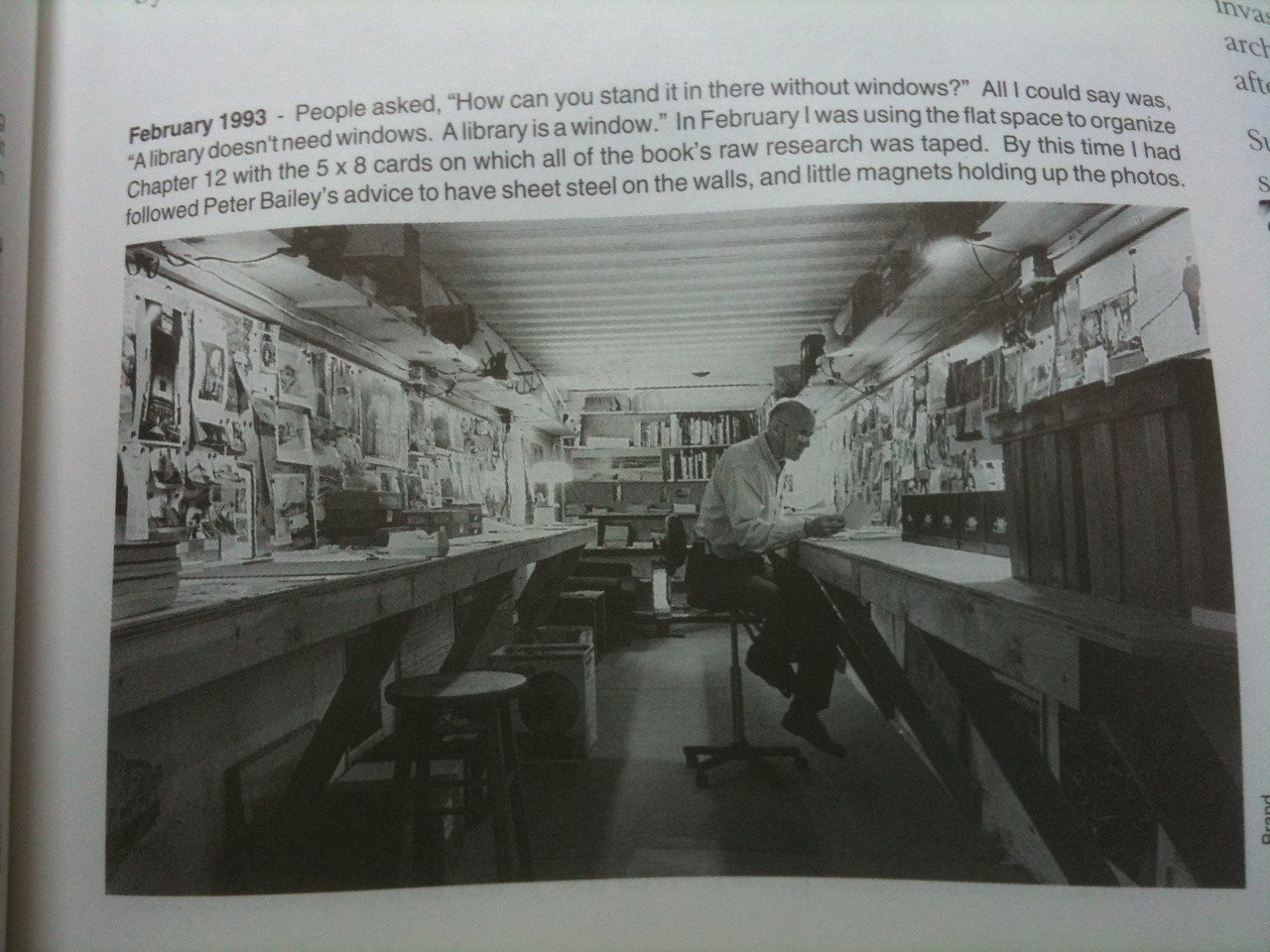
This is excellent real-making, a way of making the creative possibility very vivid. As I wrote in my essay on "Developing Creative Identity": "This is a man taking his creative work seriously. Everything about this space conveys the message: this project matters. It is a space for him to think with, to help him organize his thinking, and to connect him emotionally to his project. It is adaptable, and able to evolve in response to what he is doing; but at the same time also organized, likely reflecting and supporting the organization of the book."
Another attestation came from the designer Jony Ive in his eulogy for Steve Jobs: "Steve used to say to me, and he used to say this a lot, 'Hey Jony, here's a dopey idea.' And sometimes they were. Really dopey. Sometimes they were truly dreadful. But sometimes they took the air from the room and they left us both completely silent. Bold, crazy, magnificent ideas. Or quiet simple ones, which in their subtlety, their detail, they were utterly profound. And just as Steve loved ideas, and loved making stuff, he treated the process of creativity with a rare and a wonderful reverence. You see, I think he better than anyone understood that while ideas ultimately can be so powerful, they begin as fragile, barely formed thoughts, so easily missed, so easily compromised, so easily just squished."
Many of the pieces of work that I'm proudest of are real-making. It's something that discovery fiction especially is good at, perhaps because it involves exploration of a subject from so many angles, beginning with fundamentals, and gradually elaborating, over and over, with tremendous cumulative imagination. The result is a gift to the reader, a real expansion of their felt sense of the world. And so maybe one of my own special ways of contributing is real-making.
One of my favourite lines in literature comes from Yann Martel's book "Life of Pi". According to the author, he met an elderly man who claimed to him that "I have a story that will make you believe in God". It's an astounding promise of real-making, and one I've reflected on a lot. As a devout atheist, I naturally wondered at the possibility of a story which would make the listener believe in the cosmos. I didn't even quite know what that could mean. It seemed almost a category error. But I ran the sentence past my friend Hannu Rajaniemi, a deeply thoughtful writer, who replied that it sounded like perhaps the best artistic mission statement he'd heard. And so I've kept pondering it. There's a sense in which none of us really believe in the cosmos – not really. Our experience is of a tiny, linear, narrative cut through a vast and complex cosmos; a good life is one which is in healthy communion with that cosmos, and that, I think, requires grounding in the right intangibles. This is why religion matters: it provides a way of grounding us, a healthy way of believing in the cosmos.
Thanks to Fawaz Al Matrouk, Mona Al Subaei, Nadia Asparouhova, Joe Carlsmith, David Chapman, Laura Deming, Cate Hall, Henrik Karlsson, Andy Matuschak, Catherine Olsson, and Hannu Rajaniemi for conversations on related topics.
This is also a common observation about love. I don't think this is a coincidence. Both love and belief are consequences of related processes of invested attention.↩︎
Indeed: it's much harder to understand and believe the sense in which they are an illusion, as enunciated by Buddhism. It amuses me to imagine a book: "How everyday objects become unreal".↩︎
There are many reasons for this. One is that our belief-making process is a pretty lousy truth-determining process. Another is that our best truth-determining processes seem to be pretty lousy belief-making processes (they tend to be detailed, boring, time-intensive, and often quite non-intuitive, the domain of specialists). Separation is a feature, not a bug. It's especially helpful in a society which benefits so much from division of labour: specialists can help determine truth, but different processes can help enable spread of belief. Of course, this can go wrong, as the recent breakdown of trust in experts in the US has illustrated, but it's also a situation with many potential benefits.↩︎
At times I got very caught up in the distinction between atheism and agnosticism. In retrospect, it seems relatively unimportant, resting more on certain conventions than any deep commitment to particular epistemics.↩︎
Joe Carlsmith, "Deep Atheism and AI Risk" (2024).↩︎
I am also a deep atheist in Carlsmith's sense: I believe the existence of sentient, technology-designing life in the cosmos is typically quite vulnerable, due to the nature of the technology development tree: such sentiences seem to me likely to self-extinguish. This is an intuition, not something I am certain of, but also not something I can shake.↩︎
See my podcast with Carlsmith on "Deep Atheism, Death, and Sincerity", at https://www.goodconversationproject.com/p/joe-carlsmith (2026).↩︎
Thanks to David Chapman for an illuminating conversation on related issues.↩︎
Luhrmann has developed the wonderfully-named "sensory delight scale", which she found correlated with people's ability to experience sensory delight. She also connects it with a widely-used measure of our capacity to be absorbed in an experience. She believes both are related to our skill at prayer and other such religious experiences. I wonder how high scientists and artists score on these scales? I also wonder at the relationship between capacity for absorption and for truth-seeking? In general, I suspect they're in tension with one another. But also: managed well, that tension may be at the heart of much great art and science.↩︎
The concepts of heresy (in Christianity) and bid'ah (in Islam) do much to inhibit change. Though the Islamic concept of bid'ah hasanah (good innovation) is notable. But the general presumption against decentralized change, often framed as respect for tradition, seems strong in many religions. Much of progress has been about developing institutions which enable decentralized change – in science, art, economics, politics, and many other areas.↩︎
Oddly, we don't have a very good word here. "Institution" carries the implication of a single organization, and I don't mean that. Science or the economy are examples of things which have many decentralized, non-authoritarian qualities, and which can change and (sometimes) improve rapidly. But neither is an institution, more like a complex of institutions and norms and individuals and social practices and so on. I'm using the term "institution" in the text to point to this kind of complex, not a single organization as such.↩︎
Upon rereading this paragraph, I realize I'm valorizing the ability to change and improve and so on. But while these things are good, they are not unqualified goods. Religion gets surprising benefits from veneration for tradition, even when those traditions contain elements which are wrong. I don't understand how to think about this very well.↩︎
Luhrmann tends to emphasize the "invisibility" of God, but preferred the term "intangible", since it's more apt for many of my examples, especially in this section. All hearing people believe deeply in sound waves because they are highly tangible for us, despite being invisible.↩︎
And chefs, farmers, doctors, and several other communities. I'm using the community of microbiologists as a non-exclusive example.↩︎
Luhrmann discusses at length the phenomenon of believers hearing God talk to them. One striking thing is that American theists often report this with trepidation, knowing it makes them sound mentally unsound, and wanting the hearer to know that they know that.↩︎
Another example comes from startups, which are organized around a hypothetical, as-yet-intangible technological idea – what I have called elsewhere a hyper-entity – which the team invests enormous effort into making real. It is a type of real-making, with many associated processes (repetition, ritual, even kinds of prayer) that are recognizable in Luhrmann. The ultimate aim is often to cause a kind of hyperstition, a sufficiently strong belief in a hyper-entity that it propels the creation of that hyper-entity in the world.↩︎
Another example is how user interfaces make things real, by providing powerful representations of things which may otherwise be hard to see. Think of the way the London Underground map reifies the Underground. Seymour Papert developed the Logo programming language in part as a way of helping people "go to Mathland", that is, become immersed in an environment whose objects and affordances made mathematics far more real – far more like being a mathematician – than the ordinary everyday environment. Of course, objects inside computers are themselves illusions: the bits inside a computer or network are co-ordinated in a pattern that provides an illusion of unity (and identity) on the screen. It's a different type of real-making. In the future, utility fogs and similar ideas may also make this possible in the physical world.↩︎
I realize that my atheism is showing. This is what I believe!↩︎
I wonder to what extent this barrier is strongest in the Abrahamic religions, in consequence of the centrality and exclusiveness of God? If it's considered important to hold God in a special place of esteem, then it seems a violation – almost a category error – to compare our relationship to God to our relationship to (say) the number pi or the concept of GDP. But setting that barrier aside seems to me quite valuable.↩︎
A recent X poll by Tim Urban asked: "Everyone in the world has to take a private vote by pressing a red or blue button. If more than 50% of people press the blue button, everyone survives. If less than 50% of people press the blue button, only people who pressed the red button survive. Which button would you press?" . Reading the replies, many say essentially: "Of course, the obvious thing to do is to choose the red button since that has no downside". Such a person apparently does not see any downside to the plausible death of several billion people; one suspects such a person doesn't really believe other people are real.↩︎
For what it's worth, I think it's most reasonably interpreted as very near to atheism, or a kind of pantheism.↩︎
This is noted in a later account by Alexander Polyhistor, and some believe he said it to give Christianity a lift. This does not change my essential point.↩︎