
I was a theoretical physicist from 1992 to 2007. It was a romantic activity, exploring the fundamental nature of the cosmos! I became a university professor, wrote papers and books, and got to explore some of the most beautiful ideas ever discovered. In parallel, I also developed a fascination with the social systems humanity uses to make knowledge. Systems like the university or peer review are immensely deep inventions: our discovery system is itself one of the great inventions of humanity! But I believed a radically better discovery system must be possible. I became obsessed with this idea, eventually giving up tenure to work on it1. My first big project was to write a book helping develop and spread the fundamental ideas underlying the modern open science movement.
I struggled with this transition. I lost my professional status and deeply-held creative identity, not to mention my salary. While I instinctively felt I was pursuing something crucial, it took years of work before I could clearly explain why it mattered, even to myself. And throughout I was uncertain what my creative identity was. Was I still a physicist? No – while I sometimes still used the techniques of physics, it was no longer my primary identity. Was I a scientist? While it was still a crucial part of how I worked, it wasn't primary either. Other identities I flirted with included open science activist, metascientist, philosopher of science, even economist. But while I used practices from all, none felt right.
I often felt great distress about this. Identity matters. To do good work, you need a strong sense of how to be effective, models for valuable work. Most often, you acquire these from the communities you belong to. As a theoretical physicist I'd been part of a notoriously proud community, with a shared story about why our work mattered, what good work is, and a pantheon of heroes. When you exit such a community, you lose all that. This is especially true when you're pursuing a nascent creative project without a strong associated identity. Still, even without such an identity, I held onto the belief that open science mattered, and continued pursuing my creative hunch.
The identity I struggled with most during that period was writer. I'd sometimes be introduced as a science writer, science journalist, science communicator, or non-fiction writer. All seemed strange to me. While I wrote many essays and eventually several books, I couldn't see myself as a "writer", certainly not in any of those genres. If I was a writer, it was in some strange unknown genre. I occasionally met highly creative people who confided similar struggles over identity: "I'm not quite sure who or what I am. A writer, maybe? An artist? A philosopher? Some kind of explorer or scientist? I'm not sure how to explain". Their friends would tell me those people were "hard to sum up" or "one of a kind". There was comfort in this: at least I wasn't alone in my struggle for identity.
The question "am I a writer?" continued to bother me. I would sometimes consider playful variants. Was Plato a writer? What about Charles Darwin? Albert Einstein? After all, much of their creative output was words on a page. Didn't that make them writers? Instinctively we know this is silly. Obviously these people are not writers – they are a philosopher, naturalist, and physicist. Einstein was "doing physics", not "writing". In some sense that answered the question. However, I suspected there were hidden depths I wasn't seeing.
In this essay, we'll take these playful questions seriously. We'll examine what many different "writers" are really doing – ranging from Darwin and Einstein to people more conventionally considered writers, like John McPhee, Jane Austen, and Ted Chiang. What is similar? What is different? What activities beyond writing feed their work? By exploring these questions we'll better understand how new creative identities emerge, often from the work of near-amateurs. We'll see that forging such creative identities often requires leaving existing communities, and becoming illegible even to oneself for a time. While this sounds obvious, it took me almost twenty years to really understand, and to construct a strong replacement identity. It's one thing to see the answer from the outside, quite another to find it from the inside.
As a first example, let's examine Stewart Brand's wonderful and very unusual book "How Buildings Learn". You get a sense of the book from the cover, which shows two buildings side by side in New Orleans. The buildings are identical when first built in 1857, but by 1993 both have changed and become very different from one another:
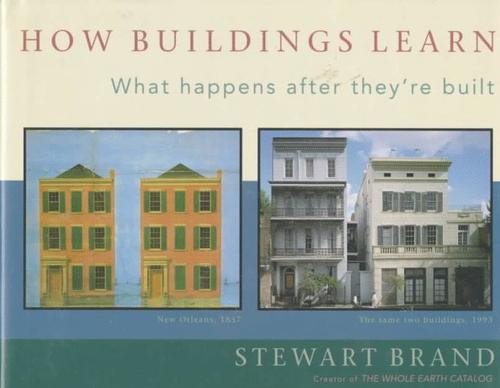
It's an unusual book. It's not conventional non-fiction, nor journalism, nor a photo essay, though it contains elements of all. Nor is it any other conventional form. It is, rather, a deep exploration of the question implied by the title: how do buildings change over time? It draws on a wide-ranging field report, collecting many examples of how buildings change, often illustrated with striking photos. From these examples, Brand extracts a kind of conceptual armory – terminology for recurring patterns in how buildings change, and simple heuristic models for the most important patterns of change. This armory is not imposed top-down or from some abstract philosophy, but arises from deep consideration of individual examples2. The reader also acquires experience evaluating buildings in these terms. How adaptable is a building? In what ways is a building adaptable? In what ways does it resist change? These questions can be applied to every element of a building's design – from the materials to the layout to the walls to the ceilings to the electrical and other fittings. And you start to understand what makes some buildings change well and others poorly, and what the impact is on human psychology and the built environment.
Let me give just one too-brief example. Brand has a lengthy, loving discussion of MIT's famous Building 20, a "temporary" building built to host radar researchers during World War II, though ultimately used for decades. It was a three-story wooden building, "The only building on campus you can cut [and thus modify] with a saw", a building which exposed the electrical and plumbing services throughout, making them easy to re-direct and augment. Brand: "Recabling from office to office, lab to lab, or even wing to wing is largely a matter of do-it-yourself. Rather than a burden, the occupants consider this a benefit."
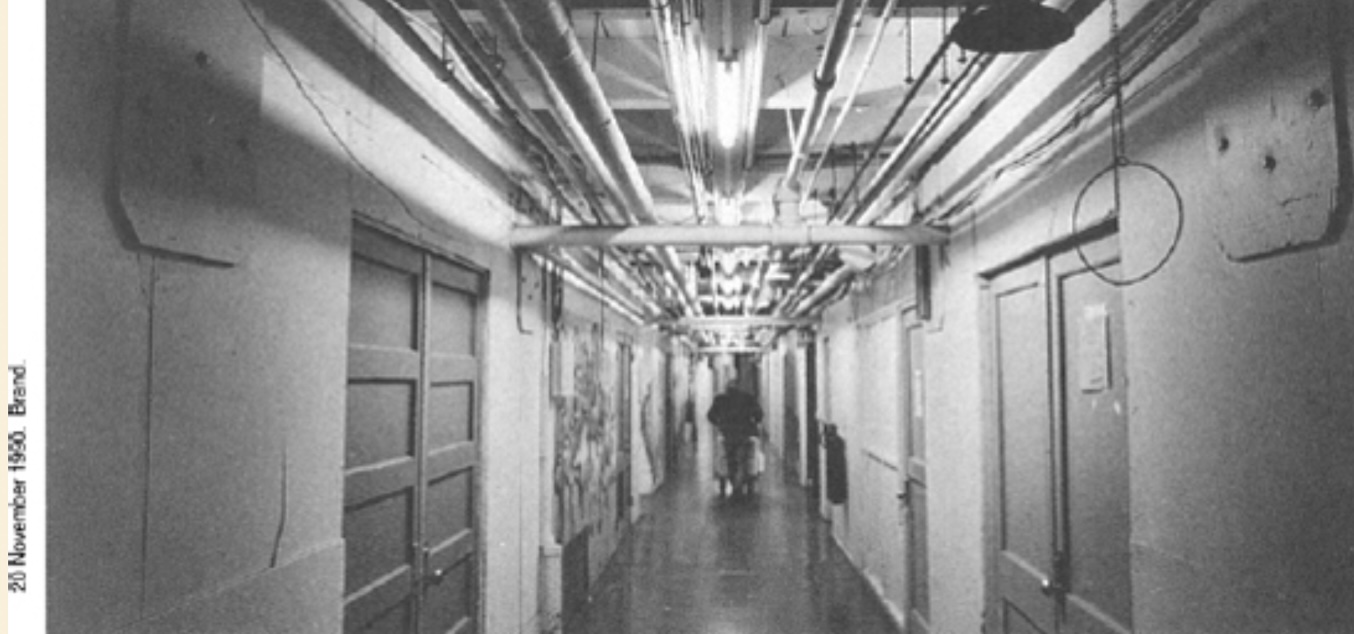
He quotes reports from occupants of the building about what they like about it: "The ability to personalize your space and shape it to various purposes. If you don't like a wall, just stick your elbow through it." (Jonathan Allan) "If you want to bore a hole in the floor to get a little extra vertical space, you do it. You don't ask. It's the best experimental building ever built." (Albert Hill) "One never needs to worry about injuring the architectural or artistic value of the environment." (Morris Halle)
This is a tiny excerpt, but you get the idea. This is the raw material from which Brand extracts his conceptual armory, and you can start to see some of the heuristic models and categories implicit above: what properties make it easy to modify a wall or ceiling? Or the practical observation that people are more willing to modify a building when they're not worried about the artistic value; this is a tension that recurs throughout, with many implications. He develops his conceptual armory through many such examples, often with discussion of edge cases and exceptions, both real and apparent. The result is that you internalize Brand's view of how buildings learn. It permanently changed the way I see buildings3.
"How Buildings Learn" is the work of someone initially approaching the subject as an amateur. I mean this as a high compliment. Brand begins with a fundamental question – how buildings learn – that is not usually taken seriously by architects. And he takes it tremendously seriously, drilling down to arrive at a viewpoint different from that of the traditional community of architects. But if he seems to have begun the project as an amateur, his depth of work means the finished project is certainly not the work of an amateur. But neither had he become an expert in any extant community either. Rather, he was developing a new kind of expertise, one in a potentially productive tension with the community of architects. This tension expresses itself through the book, as Brand points out many ways traditional architectural ideals make buildings inflexible and unresponsive to unanticipated needs. As just one example: many skyscrapers have glass curtain-wall facades, which make them architecturally striking, but also expensive and impractical to modify.
If Brand implicitly and sometimes explicitly criticises architects, how have they responded to Brand? Have they integrated this understanding into how they design? I do not know. I suspect it has only barely begun, in which case the book still presents an opportunity for some brilliant architect to bring these ideas into existing communities.
Is Brand working as a writer in "How Buildings Learn"? There are elements of photo journalism, field reporting, architectural criticism, travel writing, and more. But all are subsidiary, not the primary form. Because his question isn't founded in any existing field, he doesn't have a body of standard existing practice to draw on4. Rather, Brand is a person who cares a tremendous amount about answering a particular question, and to that end deploys every tool he can find that might help. Practices like photo journalism, travel writing and so on are simply part of a journey to find deeper answers. So Brand is not working as a writer in any recognized genre. Rather he is developing a unique written form, in response to the problems he was facing.
This point can also be made by contrasting "How Buildings Learn" with work in established genres. Consider John McPhee, who writes marvellous long form profiles of people like the basketballer Bill Bradley, the art curator Thomas Hoving, and the nuclear weapons designer Ted Taylor. In each case, McPhee shows us a well-chosen slice of the life of that person: how they think and feel, how they see and move through the world. McPhee is not aiming to develop deep answers to fundamental questions like "how do buildings learn?" While his profiles often contain insight on fundamental questions, it's not the primary purpose, and so they're not developed in nearly as much depth as Brand's answer. (McPhee's work may, however, be viewed as part of the grand collective authorial project to answer the fundamental question: "What are the varieties of human being?") While McPhee is one of my favourite writers, my own creative drive seems more like Brand, more toward fundamental questions which have received little prior attention. In such a pursuit, McPhee-style profiles may be useful tools, but are not the primary point. And because such questions are often outside or on the border of existing fields, addressing them often demands the use of novel combinations of tools, giving rise to a unique written form.
Darwin's "On the Origin of Species" is another book that, like "How Buildings Learn", is a deep exploration of a fundamental question: how does the immense variety of the biological world arise? But it also illustrates important new patterns and problems. For instance: for much of the Origin, Darwin writes beautifully, holding and developing the reader's interest. And for much of the Origin he is tedious, long-winded, even just plain boring. Why does a good prose stylist so often slip into tedium?
It's not an accident. Darwin's primary goal is not that of a general non-fiction author, holding the reader's interest with beautiful prose, gripping stories, and a compelling narrative arc. Rather, his goal is to convincingly answer his fundamental question: how does the variety in the biological world arise? Darwin writes beautifully and interestingly when he can, but those goals are kept subsidiary to making progress on his fundamental question.
For example, there is a lot about pigeons in the Origin. It's high quality evidence and argument, but even someone who loved pigeons might find it tedious! More broadly: often Darwin needs evidence for some assertion in the form of a long list of facts. And so long lists of facts we get. Often his best arguments are long and detailed and involve hedging and special cases and identification of weaknesses. And so they go in too.
The tension here is that what is interesting is not always true; what is true is not always interesting. And this applies not only to the truth, but also to convincing evidence and to good explanations. Darwin prioritizes truth, evidence, and explanation, and that strongly shapes his writing.
Like Brand, Darwin seems determined to use any form of engagement with the world which will help him answer his question. Darwin is a remarkable explorer, observer of tiny details, taxonomist, comparative anatomist, correspondent with a far-flung network of naturalists – he must have been an extraordinary letter writer – collector and arranger of tidbits of information from all over the world, synthesist, and theorizer over many layers of abstraction. He is deeply connected to many communities of practice, and willing to use their written forms.
These different forms are often arranged in a kind of "long zoom", a term I've borrowed from the writer Steven Berlin Johnson. Darwin will make long lists of detailed observations, combining his own work with that of his network of naturalists. And then zoom out to explain that list. And then zoom out again to connect to other explanations. And then zoom out again, until eventually we see interrelationships in the biosphere whole. It is dizzying and extraordinary, this seeing and integrating at so many different levels of detail, zooming both out and in, all in service of his overall project.
And so, like "How Buildings Learn", the Origin is a unique book, deploying many different types of writing and ways of engaging the world, anything to help answer its fundamental question. But unlike Brand, Darwin's main contribution is to identify and make the case for a single principle: that of evolution by natural selection. The book is both an argument the principle is correct and a discussion of the consequences for biology. Darwin realizes his principle will remake biology5, and works hard to integrate it into the best biological thinking, in a way Brand does not for architecture. In so doing, the book becomes a prototype for future work in biology and even beyond, in domains such as human and animal psychology. As Darwin realized, he'd discovered a fundamental new type of explanation.
Both Brand and Darwin are writing to discover6. But they're doing it in different ways. Darwin only decided to write the Origin after he'd already understood the principle of evolution by natural selection7. That is, he had not only his question, but also confidence in his answer, building on decades of prior work and creative output. And so Darwin is sharpening and developing an idea he already believes; he also, en route, discovers many surprising implications and applications. By contrast, Brand seems to have begun with a question, and discovered the basic shape of his answer through the writing process. Brand is a sailor, setting out on a voyage, determined to tell the highlights of the story, no matter what happens. Darwin is a sailor who has gone on a voyage – I mean figuratively, though it was also literally true – and seen wonders enough to want to tell the story of what he has discovered. Of course, he expects that writing will also be a vehicle to discover still more in the telling. Brand is closer to writing-to-explore; Darwin is closer to writing-with-a-goal, although each has elements of the other.
I'm fascinated by this distinction in possible goals for writing. In my own work I've operated on both sides of the divide. Writing-to-explore is more difficult, since you're not always sure you will discover things worth the telling. You begin with a hunch, and it often only slowly turns into certainty. Whereas Darwin must have had near certainty at the outset – his central result having arisen out of earlier activities, most famously the Voyage of the Beagle, which had their own independent purpose.
I began with the question "Am I a writer?", and playful questions like "Was Darwin a writer?" Of course, we know Darwin wasn't a writer; he was "doing biology", going out and making detailed observations of the world, collecting data, and so on. That's what made him a biologist. There's a big difference between those activities and writing. The trouble is: there isn't really a firm boundary. As the Brand and McPhee examples illustrate, every writer observes the world; many do so quite systematically; many will draw very deeply on the practices of existing specialist communities. There is no firm boundary between the activities of a general writer and those of a specialist like Darwin. In fact, the latter emerge out of the former. It's telling that Darwin doesn't seem to have thought of himself as a biologist. While the term was used in his time, he seems to have thought of himself as a naturalist, emerging out of the great tradition of amateur English naturalists. I won't try to resolve this now. It's more helpful to observe, and hold the tension, and just continue exploring the practices of different creative people. But we'll come back to it.
This was Einstein's first paper on special relativity, published in 1905, showing that time and space are radically different from how they appear: they are mutable and interchangeable in a way shocking to ordinary human intuition. This also makes things like length and simultaneity different than we instinctively assume. These conclusions were partly anticipated in earlier work by Fitzgerald, Lorentz, and Poincare. But Einstein's work gives a more forceful and fundamental explanation. He transformed our notions of space and time.
Is Einstein a writer? It seems a ridiculous notion. He's obviously doing something much more specialized than any conventional type of writing. His paper was published in the journal Annalen der Physik, he had just submitted his PhD thesis in physics – he was obviously a physicist.
Still, if you consider Einstein's progenitors, the situation is less clear. Consider the ancient Greek philosopher Empedocles, who in the 5th century BCE developed a theory in which the fundamental constituents of the universe are fire, air, water, and earth. Like Einstein, he helped understand the fundamental constituents of our world, and influenced later thinkers from Aristotle to Boyle, and through them more recent scientists like Einstein8. But Empedocles didn't propose his theory in a scientific paper. In fact, he wrote his major work in hexameter verse, the same meter used by Homer. So too did Lucretius, with his famous work arguing that the cosmos is made of atoms moving through empty space. And so too Parmenides, writing on the nature of time and change and reality. Some of the most important works in the history of science and philosophy were in the form of poetry! Perhaps Nature and The Physical Review should give it a go.
I've sometimes wondered how these early thinkers self-identified. Did Empedocles ever think of himself primarily as a poet, with an unusually strong interest in the physical world? What about Lucretius or Parmenides? It seems distinctly possible!
This seems like a humorous anecdote, but it's deeper. As we develop new means of understanding and explaining the world, we develop new literary forms. But those means of understanding and explaining emerge only slowly, as do the forms. Empedocles wasn't a fool to write as he did. Rather, he was using the medium he knew in order to develop his understanding. But he was also modifying and developing the medium to support new kinds of thought and new representations for that thought. Viewed this way, writing is a mutable, extensible tool that can be used to gradually expand the ways we make sense of the world. It evolves in concert with corresponding activities in the physical world – ways of observing and intervening, ways of making sense. Areas of expertise like physics and biology don't emerge fully formed. Rather they begin with activities and a written record scarcely distinguishable from other everyday activities. It's only over a very long time that a distinct body of knowledge and ways of engaging with the world gradually arise. Writing can thus be used as a medium to develop new ways of understanding.
We can look at our earlier examples through this lens. "How Buildings Learn" is the work of an extremely talented and devoted amateur. It's tempting to compare to Empedocles, starting from scratch. But Brand has many more models of work available to him than Empedocles. An even better comparison is perhaps Galileo, who laid the foundation for entire subjects, starting from modest-but-real foundations. Or, to return to an example from the introduction, to Plato, from a time when philosophy was beginning to differentiate from common thought. Plato was both writer and philosopher – a kind of proto-philosopher. Einstein, by contrast, builds on an immensely deep community of practice, with centuries of development. Indeed, so deep that not only can most other people not write like that, most can't even read like that9. But it wasn't always that way. Einstein is recognizably an intellectual descendant of people like Galileo, and still further back of Empedocles. Darwin's "The Origin of Species" is an intermediate case, emerging out of a network of communities of practice, but those communities did not yet have the depth of physics in 1905.
Brand, Darwin, and Einstein thus illustrate different stages in how written forms, types of understanding, and expert community develop together – from amateur exploration to deep community of practice. But all begin as part of the common conversation of humanity, and only gradually specialize over time.
I noted earlier Darwin's realization that almost every question in biology needs to be rethought in the light of natural selection. Similarly, Einstein's changed understanding of space and time remakes something both universal and fundamental in our understanding of the cosmos. So much so that it seems plausible that aliens billions of light years away10 will also experience space and time as fundamental; and perhaps go through a similar arc of discovering the Descartes-Galileo-Newton mathematical description of space and time, and then improve upon it by discovering special and general relativity11.
Einstein's paper has a set of takeaways, precise mathematical relationships that can be reused exactly in other contexts – the Lorentz transformations12, for instance, are a set of mathematical equations describing how space and time measurements are related in different reference frames. Or, from a later paper by Einstein on relativity, perhaps the most famous equation of all: E = mc^2. These work as a kind of interface or API to these papers: they express exact conclusions, which you can reuse elsewhere, even without reference to the paper's argument for why they're correct. And because space and time are so fundamental, these results are reused everywhere, from engineering to chemistry to navigation to science fiction. In short, this understanding propagates out to affect our entire understanding of the world. It is a truly incredible fact that these expressions – squiggles on paper! – can express so precisely such a powerful understanding of the world. Darwin's book also offers such a principle, albeit somewhat less precise, but so forcefully articulated and applied in multiple contexts by Darwin that it too can easily be reused elsewhere. Brand's conceptual armory is somewhat less precise still, but still useful enough that it too can be reused. All three are triumphs of human understanding of the world, and of our ability to express and apply that understanding in multiple contexts13.
I began this essay by asking if people like Einstein and Darwin could be considered writers. Let's invert that question, and contrast with the people most conventionally considered writers – the authors of fictional stories like "Hamlet" or "Pride and Prejudice" or "Stoner". We don't strictly need this to answer the question of the essay. But it will help us better understand what writing is capable of, what the space of creative identities can be. At first glance, such stories seem to do something quite different from our earlier examples: they evoke alternate worlds, and other ways of experiencing the world14. The philosophers tell us we cannot know what it is like to be a bat; undeterred, ambitious novelists may aspire to let us experience what it is like to be Hamlet, Miss Elizabeth Bennet, William Stoner, or even stranger others.
Sometimes, a writer takes on an especially great challenge. Nabokov takes us inside the mind of a pedophile, Humbert Humbert, in "Lolita". While Humbert Humbert is gross and repellent, Nabokov makes the story so compelling we cannot look away. We are inside the monster's mind, experiencing in first person, closer even than in "Hamlet", "Pride and Prejudice", or "Stoner". Even more impressive: Nabokov does not (for the most part) make it compelling through "true crime" sensationalism. Zadie Smith's comment is apt: "Lolita seemed like the page was on fire… I didn't know a book could do that."
Our non-story examples, Brand, Darwin, and Einstein, are not primarily about giving us such an experience of being. Rather, they improve our descriptive understanding of the world. Of course, stories like "Hamlet" et al also improve our descriptive understanding – fiction is sometimes better psychology than the psychologists, and better political science than the political scientists – but it's not the principal point. There is no API for Hamlet. The principal point is the experience itself15.
We've been discussing story-as-experience. But let me describe two striking variations on this goal16. One is illustrated by one of my favourite short stories, Ted Chiang's astonishing "Story of Your Life" (spoilers ahead!). It is ostensibly the story of a woman who: falls in love and then divorces; has a daughter as fruit of that union; whose daughter later dies; and – the most obviously science fictional element – who helps humanity learn to communicate with a race of aliens.
The conceit of the story is that the aliens experience time very differently than humans. They experience all times simultaneously, so from a human point of view they seem to be experiencing not only the past and present, but also the future as a kind of inevitable unfolding, something that has already happened. Furthermore, Chiang sketches a way this experience of time can be passed from the aliens to the human beings interacting with them. Our narrator gradually internalizes this altered experience of the world. It's fiction and you need to suspend disbelief, but it's compelling enough to work as story.
As I read "Story of Your Life" for the first time I found the voice of the narrator strange. She seemed detached, almost emotionless. Not entirely unfeeling – she could be wry, or ironic, or humorous. But there was a distance to her. When terrible events occurred – like the death of her daughter – that distance became acute, a seeming inhumanity. I couldn't make sense of it. Then: a radical perspective shift, an epiphany, as all the dissonant moments suddenly fell into place: this is what it was like for her to experience this state of temporal consciousness. Everything that had hitherto read as strange now made sense, her dispassion, the wry irony, everything. Strangest of all, I felt some tiny hint of this unfamiliar state of consciousness in myself. It was one of the most wildly vertiginous and disorienting experiences of my life. I have reread the story many times since, and each time feel that same sense, though never as strong nor as sudden as the first time, that sense of starting to slip into a way of seeing my life entire, of understanding that will and the power to choose is not distinct from fate and predetermination.
Great stories – indeed, great writing of any type – create a powerful new context for us to think in17. But sometimes, very rarely, they may create new states of consciousness, new states which alter who we are, however momentarily and incompletely. Obviously, "Story of Your Life" didn't give me the ability to see the future. But it was an extremely vivid experience and reminder that there are profoundly different ways of being for humanity, and perhaps even more profound for the alien other18.
Another striking example is the Christian Bible. I've puzzled a lot about what it's doing. It's a collection created by multiple authors across centuries, so one might expect less clarity of purpose. The best brief answer I can find: the Bible is providing an identity for a people19. It is saying: here is how you came to be. Here is what you have done through your history, your highs and your lows, your potential for the future, what you are capable of. And here are demanding standards for what it means to be truly successful: individually, as a family, as a community, as a culture. It is providing a model for how to be in the cosmos.
It is surprising how effective the Bible is as writing. Its authors wrote long before Nabokov or Williams or Austen or Shakespeare, and without the benefit of the literary invention available to the later authors. Yet many of the stories have great power. The story of the Crucifixion, in particular, is one of the most powerful stories ever told: the Son of God came into the world and loved you – yes you – so much that he accepted an excruciating and unjust death, in order to save you from the consequences of your sins. That's a story so extraordinary as to be transformative of individual and cultural identity! That force has been amplified by being retold so often. Creators from Leonardo to Andrew Lloyd Webber to Dante to Martin Luther King, Jr. to Monty Python have all written riffs on Biblical stories. The Bible thus has the best and most varied fan fiction of all time; indeed, much of modern culture is extrusion from the Bible. If Chiang can briefly transform the consciousness of a reader, the Bible has durably transformed the consciousness of our culture.
We've been discussing story forms. There are also many striking adjacent forms. One of my favorite forms to write in is what I call discovery fiction. Some examples include this Twitter thread explaining how a person with a basic knowledge of quantum mechanics could come to invent quantum teleportation, and this essay explaining how a person could come to invent the Bitcoin protocol. (More examples here). The general idea is that discovery fiction provides a plausible story of how the reader could have discovered a result such as the Bitcoin protocol. Typically, there's an arc of small questions and ideas, false starts and backtracking, incremental steps eventually leading to the result. Ideally, none of these things should come out of thin air: they should all be simple, almost-obvious steps, the kind of thing where the reader can think "oh, yeah, I might well have tried that, maybe not as my first choice, but after a little thought".
The experience for the reader is of gradually coming to understand the result from the inside. At first such grand results often seem daunting and near incomprehensible. And then, bit by bit, insight dawns. You face creative choices and their consequences; you chase down false starts and discover why better choices work. This creates a consciousness of what it is like to invent something like teleportation or Bitcoin. You don't merely understand the result, you experience and understand why it is that way. Discovery fiction does not need to be historically accurate – indeed, history is often much more random and confusing. It's instead a kind of fictional non-fiction, aiming like a story to provide an experience, but an experience of discovery.
I have many aspirational ideas for discovery fiction. Among others, I've got notes toward "How to discover that space and time are not as they appear" (on discovering relativity), "How to discover a law of nature", "How to discover a mathematical theorem", and even "How to discover science". The aspiration of a piece like "How to discover that space and time are not as they appear" is for the reader not merely to know what Einstein knew. But rather to start to see the world as Einstein saw it, to in some small measure transform their consciousness.
Another powerful story-adjacent form is used by Robert Caro in his acclaimed biography of US President Lyndon Johnson. As Tanner Greer has pointed out, Caro's book incorporates powerful techniques of fictional storytelling in a manner unusual in history and biography. Those genres usually adhere to the convention that the writer cannot report what a subject was thinking or feeling, unless the subject has explicitly said it – perhaps in an interview or memoir or diary, or to some other reliable source20. By contrast, a great advantage of fictional stories is that you can describe the experience of the characters in ways non-fiction currently21 cannot – what they're thinking, what they're feeling, even evoke parts of their being they may themselves be unconscious of. These are powerful advantages for fiction22.
Caro uses a clever technique to combine the benefits of fiction and non-fiction. In telling Johnson's story, Caro amasses a great deal of detailed factual information. But he occasionally breaks his factual narrative to speculate on what Johnson was thinking or feeling. It is clearly marked as speculation, but the factual portrait is so compelling, and Caro's understanding of Johnson so acute, that you find yourself believing Caro's speculation: you are taken inside Johnson's experience. And so you get the force and veracity and surprise of truth, but also the transformative experience of fiction.
Like Brand and Darwin, Caro illustrates the power in combining multiple forms of engagement with the world. And techniques like discovery fiction and Caro's speculative interiority show how the techniques of fiction can be useful for purposes beyond conventional fiction.
What is story? It's not so obvious. We all recognize stories. But I've found it hard to explain to myself what a story is, much less a good story. I enjoy Douglas Adams' quip that a story is "80,000 words in a cunning order". It's both a good joke and a striking insight. But I suspect Adams said it partly to dodge the question of what a story is. But an idea I enjoy playing with is that a story is a premise that makes you strongly desire to know what happens next, and which continues until that feeling is satisfied23.
Good story and good explanation superficially have much in common. But they are very different. Something can be a good story and a bad explanation; or a good explanation and a bad story. We saw this in Darwin, with his willingness to sacrifice good story for a deeper understanding of the world. Keeping clear on the distinction can prevent much confusion (and, occasionally, misery). It's been an ongoing challenge of the social media age, where good-but-false stories often propagate more easily than good explanations which make bad stories.
Story's origin seems almost certainly to lie deep within our evolutionary past. It's strange, because chimps and other animals do not, as far as we know, tell stories. But it's hard to not believe the roots lie deep. Perhaps that's why we so often confuse story with reality! I love Muriel Rukeyser's line: "The universe is made up of stories, not atoms". This is true, in the sense of human experience: our minds are narrativized. But there is also an unself out there, a cosmos beyond our selves, which can't be narrativized through a single line to be held by human consciousness. The cosmos is beyond narrative. But a great story can be a way of selecting through real or imagined worlds, to evoke something of the broader cosmos, a bridging of self and unself.
In his memoir "On Writing" the writer Stephen King tells of how he sets himself a goal of writing 2,000 words each day, for whatever novel he has in progress. As he points out, at that pace, even with multiple drafts, you can write a sizeable book each year.
This works for King. He lives in a quiet part of Maine. He rarely travels. He has previously internalized a tremendous number of story patterns and ideas. And he continues to feed his story demon, writing in the morning, and complementing it by reading in the afternoon. His prior understanding and his reading combine to generate enough ideas to feed a 2,000 word per day goal.
The caveat is that this approach is tailored to the particular types of story King likes to tell.
I mention this because King's 2,000 word-per-day goal has exerted a strong fascination over me. King presents his argument well and with conviction. And I've sometimes felt that I'm failing because I can't consistently do the same, even for a more modest goal (say, 600 words per day). This is obviously ridiculous for the kind of creative work I do. But it's also an example of the problems confusion about identity can cause. If you are wondering "Am I a writer?" and see a compelling argument you should be able to do something, and you can't, you wonder: am I just doing this wrong? Of course, King and I have radically different creative goals. But for a long time I struggled to articulate those sufficiently compellingly to escape the grip of why-not-2,000-words-per-day24. In this section, I remedy that.
This is Stewart Brand, inside the shipping container in which he wrote "How Buildings Learn":
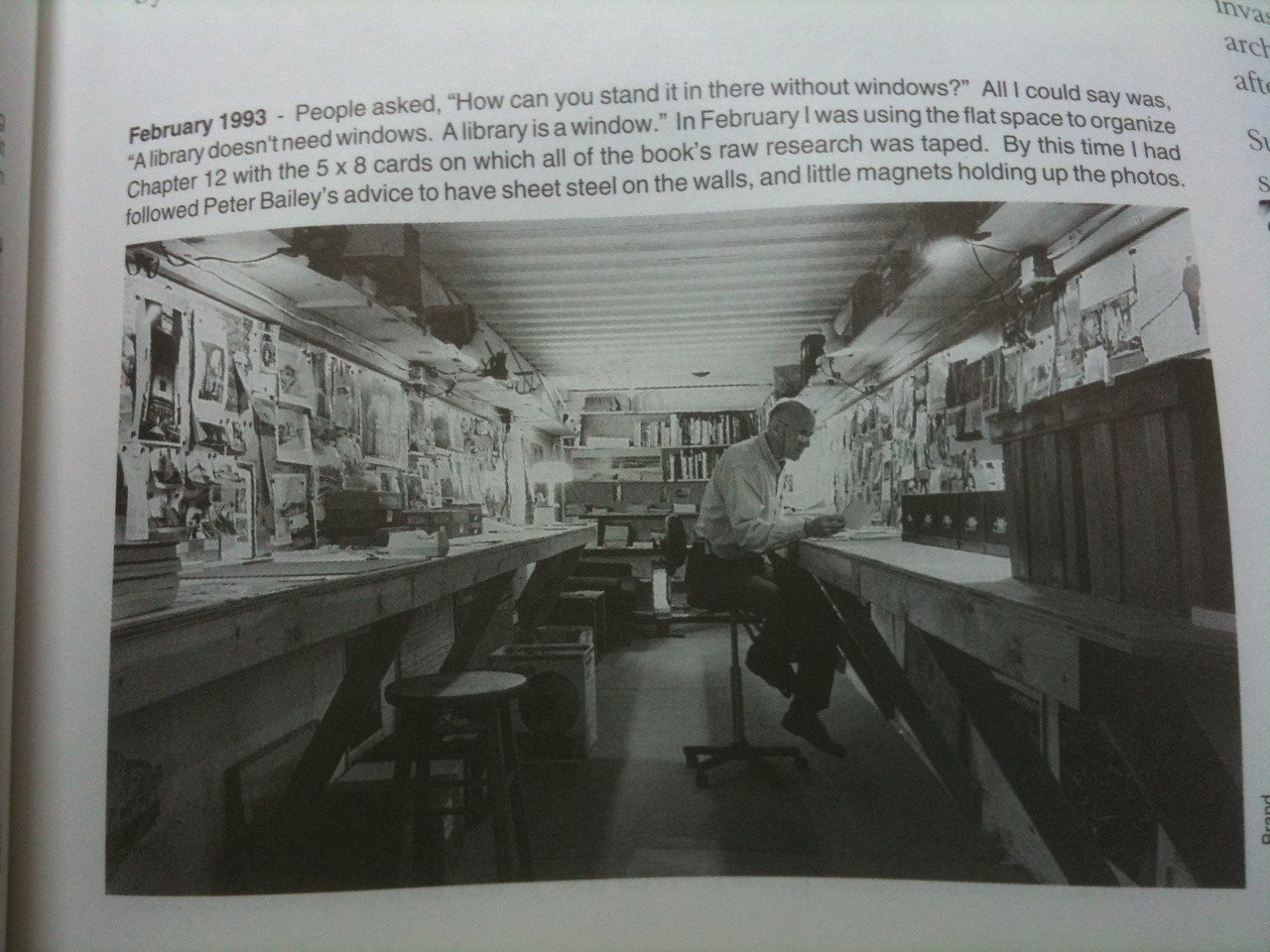
He is thinking inside the box. This is a man taking his creative work seriously. Everything about this space conveys the message: this project matters. It is a space for him to think with, to help him organize his thinking, and to connect him emotionally to his project. It is adaptable, and able to evolve in response to what he is doing; but at the same time also organized, likely reflecting and supporting the organization of the book. I've often talked this image over with other creative researchers, many of whom find it inspiring.
If Brand brought great creative force to his book, Darwin's commitment was even more extraordinary. "The Origin of Species" was the summit of a remarkable life, lived with tremendous force that – in retrospect! – was preparation for writing the Origin. Darwin began that with the 5-year Voyage of the Beagle, travelling around the entire world. He endured disease, seasickness, one of the largest earthquakes ever recorded, a near-shipwreck, and many other disasters. But through it all he was a consummate naturalist, exploring and observing and sending detailed accounts back to England. Darwin understood, with a conviction almost no-one else in history could match, the tremendous diversity in the biological world, the "endless forms most beautiful and most wonderful" that surround us. After returning from his voyage, he spent years studying, in correspondence with naturalists all over the world, and completing several other books which are minor classics. He was in deep emotional and intellectual and practical communion with the natural world. You get a similar sense from Einstein's letters25, another deep communion with the order underlying the cosmos. At times, reading him brings tears to my eyes.
Writers sometimes talk about their "research process". The term is useful, but far too limited. Ben Franklin's "research process" for his renowned autobiography was to live his incredible life. For his book "Seven Pillars of Wisdom", T. E. Lawrence helped enable the Arab Revolt against the Ottoman Empire, during World War I. That's quite a research process. Einstein not only brought much of his life to his paper on special relativity, he also brought centuries of the best human thought and experiment. Similar remarks may be made about Brand and Darwin. A person with a sufficiently rich life will always have material for an incredible book, whether they choose to write or not26. A better question for any creative person is: what activities do you want to pursue? What kinds of understanding will that create? How far can you go, exploring more deeply, more forcefully, more imaginatively? And what communities offer powerful tools that you can use to deepen your understanding?
There is a sad counterpart to all this. Many people who self-identify as writers bemoan their day jobs. If only they could quit those pesky jobs! That would speed them up and let them flourish as writers! Finally after screwing up their courage they quit their job. Surprisingly often, this causes their writing to dry up. They didn't understand that the everyday activities "blocking their writing" were crucial to generating material. Writing doesn't come from nothing. For anyone who writes – indeed, anyone who creates in any way – it comes out of some other source. You need activities that generate the insight your writing is founded in. Sometimes that's other books, as it apparently is for Stephen King. Sometimes it's a penetrating investigation of the world, as in the Brand or Darwin examples. Sometimes it's to help found a country, as in Ben Franklin's. And sometimes they draw on immensely deep and established communities of expert practice, as in Einstein's case. Again, the question is: what activities will generate the types of understanding you seek? And how can you deepen those activities as you write, a loop in which your writing practice co-evolves with how you enter the world, to generate more and deeper insight?
In "On Writing", King criticises Harper Lee for writing only one book27, "To Kill a Mockingbird". King expresses admiration for the book, but also asks: what was she spending all her time doing? Why didn't she write more? The answer, of course, is that the way Lee generated insight was very different from King's. It was much closer to Ben Franklin or T. E. Lawrence's: she spent decades living in (and closely observing) Jim Crow Alabama. And while King is a fine writer, he hasn't written anything to match "To Kill a Mockingbird"28. Lee's process might be slow. But it generated a remarkable understanding of the world, and an equally remarkable book.
Let me return to my opening question: "Am I a writer?" The answer is far more subtle than I initially apprehended. Brand, Darwin, and Einstein are all in some measure writers – they were all using words as a medium for understanding29. For practical purposes, a useful question is: what's your primary intended creative output? If your emotional investment is mostly in writing a book, then you may reasonably classify yourself as a writer. In that sense, I believe Brand was working as a writer when he wrote "How Buildings Learn". But Darwin's main investment was in exploring the natural world, and participating in related communities. Darwin was an explorer and researcher who also wrote. I empathize a lot with that. I also empathize with Richard Feynman when he says: "I'm an explorer, okay? I get curious about everything, and I want to investigate all kinds of stuff." Being a writer alone is, for me, too isolating. Exploring and writing are not in tension; rather they support and reinforce each other.
In this point of view, the confusion over "Am I a writer?" dissolves into unimportance. It's like asking: "Am I a speaker?" Well, yes, in the sense that I use language to develop my understanding. The confusion only arises because writing is both an identity and also a medium for understanding, a medium which can be used to support other very different identities. For people pursuing unusual creative work without an associated expert identity, "writer" is thus tempting as a fallback identity. While natural, this can also be misleading, even damaging, if it suggests the wrong models for working. In this view, it's an accident that this essay is about writing at all. I'm not a writer. I'm an explorer and researcher who also writes. More precisely: I'm someone who gets interested in under-explored fundamental questions, and then pursues them with whatever tools seem most powerful, writing among them. That's still not an easily legible identity to other people; it's not going on a bumper sticker30. But it captures much of my creative drive.
I feel foolish for not forcefully articulating this to myself much earlier. But it takes time to become legible to oneself when outside well-defined communities31. Now I can confidently answer the personal identity question I posed at the beginning. I am in some measure a scientist, a physicist, an interface designer, a writer, and many more identities. But all are subsidiary and in service to my primary identity as a creative explorer and researcher. This includes the scientist in me – but by scientist I mean in a sense closer to Darwin or Brand, rather than a modern specialist in some professionalized subfield. For me a prototypical model like Brand or Darwin is much better than someone like Stephen King. Writing is merely one vehicle to express and develop my understanding. But it's my servant, not a master or primary identity. This all sounds like an easy conclusion, but for me it was hard won through experience. And many other creative workers travel a similarly twisting path. A better question is: what kind of writer can I be in service of my primary identity?
Having freed myself from the tyranny of "writer" as a primary identity, it's fun to ask: what kind of writing do I like to do, in service of creative exploration and research? For myself, I love writing to discover – writing and exploration of the world in dialog with each other. I love writing as a place to think and understand, as a powerful context not only for the reader to think in, but as an even more powerful context for the writer to think in. It's writing as a place for slow courage, for chutzpah and imagination. I used to aspire to write quickly. But if your writing is providing a powerful context to think in, then you should want that process to continue for as long as it's rapidly generating additional insight.
In writing to discover, there is a question of how much you hide the discovery in the eventual text. Background notes and first drafts are usually about the process of discovery. But in later drafts you can, if you choose, convert raw exploration into what seems like revealed insight, hiding the signposts to construction. All writers hide thought to some extent32, both as a practical matter – no-one can capture all their thinking – and as a courtesy to the reader, eliding their least interesting thinking. But how much is hidden is a matter of choice and will. Doing that hiding is often a lot of extra work. In this essay I've done a little elision, but I've also left many signposts to construction in, so the essay is itself an experience of discovery, for you the reader and for me the author.
I love writing to drill down on fundamental questions in nascent or yet-to-exist fields. This pattern underlies my books or book-length essays on open science, metascience, tools for thought, the mnemonic medium, and others. But I am wary of this too. It can easily turn to dilettantism. I often meet people who tell me they'd like to do what I do, exploring a wide range of fundamental questions. But to do so you need to find insights which are genuinely new and useful not merely to you, but (ideally) to humanity. That's a demanding standard. And while I say "drill down on fundamental questions" often there is no well-formed starting question, merely a hunch there is something worth exploring. So you must endure creative fog and confusion and ignorance, to find questions worth drilling down on, all without knowing whether you will eventually find insights worth the effort!
I love writing as a way of making a unique contribution. I talked once to a well-known scientist working in the ultra-competitive world of CRISPR. He remarked that (roughly) "of course, much of the reason we scientists do the work is the thrill of the race", remarking fondly on instances where he had "beaten" another lab or labs to a result by a day or a few days, or lost the "race" by an equally thin margin. I was astonished. I'd far rather work on something where I will be making a unique contribution, not something easily substitutable.
In all the above, I see many similar patterns in Brand and Darwin, and in many other creative workers I admire. I do not know if that's how they see it. But it's how I see it, from the outside. Perhaps more unusually, I love to write discovery fiction, to give myself and others some experience of what it is like to discover a set of ideas from the inside. I love that blurring of experience and description, the way we can come to appreciate the discovery, a changed state of consciousness. More generally: I believe story is underrated outside fiction. I love finding new ways to bridge experience and description, giving people both an experience of the other, and also powerful descriptions of the other. The fusion is far more powerful than either alone. And I also love to write about possibility, to attempt to evoke in the reader (and myself) a sense of new worlds to explore.
Something I do not do: I do not write beautifully. Poets find meaning in this aspiration, using texture and resonance to evoke more than it seems ought to be possible. And many other writers do too, especially writers of literary fiction. Many believe with Flaubert that a "good sentence in prose should be like a good line in poetry, unchangeable, as rhythmic, as sonorous". I know it improves the experience, but my first fidelity is rather to understanding plainly expressed. Writing true sentences is hard enough. With that said, as my friend Fawaz Al Matrouk has emphasized to me, there often is enormous beauty in sharply distilled understanding of the world. That is an aspiration toward beauty that I feel deeply.
Another thing I have only a little interest in: writing to educate or to reach a wide audience. I'm happy and often grateful when people find what I write useful in these ways. But it's not a primary emotional drive. When I lean on these aspirations I find myself exhausted and uninterested. Even my textbook (with Ike Chuang) on quantum computing, which many think of as educational, was mostly written to explain the field to myself and, when possible, to push a little creatively beyond. I'm delighted this work has been helpful to others. But it was only a small part of the motivation, not primary.
Writing is a miraculous technology to support exploration and discovery, enabling a kind of gradient ascent in human understanding. You make tiny improvements, over and over. It may be a word or phrase you throw out and replace with a better; it may be an entire book. Robert Louis Stevenson is said to have thrown the first draft of "Dr. Jekyll and Mr. Hyde" into the fire. You write down your confusions, your discomforts, your exceptions, your crazy ideas. And slowly, you agglomerate improvement. You can keep improving for years. I do not believe you can think well without using an external medium33, something to help you improve thoughts too complex for your unaided mind. This can be a trudge, all those often tiny improvements in understanding. But it adds up and at peak moments is transformative. As the New Yorker editor William Shawn said to John McPhee: "It takes as long as it takes." And for those of us developing new creative identities, writing is one of the most powerful servants we have.
I've benefited from discussions with many people about creative identity over the decades. A few who contributed especially to this piece include: Fawaz Al Matrouk, Mona Al Subaei, Sundus Alfe, Nadia Asparouhova, Sebastian Bensusan, David Chapman, Ted Chiang, Seemay Chou, Laura Deming, Paul Graham, Henrik Karlsson, Andy Matuschak, Niko McCarty, Toby Ord, Kanjun Qiu, Hannu Rajaniemi, Grant Sanderson, Roei Schuester, and Michaela Smith. My apologies and thanks to the many (many!) others not listed, but who have influenced my thinking about these topics.
Perhaps ironically, my institution would not allow me to pursue such work; I was to leave or work on more conventional topics.↩︎
This practice – especially identifying new types of object and actions and explaining their relationships – is one of the most profound and often creative things we humans do. One of my favourite explorations of a slice of this problem is Imre Lakatos's wonderful book "Proofs and Refutations", which is in part about what it means to make good definitions. In a different vein, my essay "Thought as a Technology" explores related questions, from the point of view of computer interface design – where do powerful fundamental new interface primitives (objects and actions) come from?↩︎
For me, an even stronger form of this effect comes from Jane Jacobs' magnificent book "The Death and Life of Great American Cities". I cannot walk through a city – especially an area new to me – without seeing it through Jacobs' book.↩︎
He does discuss – and largely reject – conventional theories of architecture as sources of good answers.↩︎
The term "biology" was in use by 1859, but Darwin himself would more likely have used the term "natural history". I am using the appropriate modern terminology.↩︎
I first heard this marvellous phrase from Louis Dennis.↩︎
When he "decided" to write the Origin is somewhat nebulous: he wrote some early sketches, began to write a "big book", and then rushed an abstract out in response to Wallace's partial anticipation of his argument. But his understanding of the principle of evolution seems to have been quite clear even very early in this process.↩︎
An even closer parallel was in three of Einstein's other 1905 publications, which gave evidence for the atomic theory (two publications) and for photons. These can all be considered direct descendants of Empedocles and Lucretius.↩︎
Incidentally, people often complain that academic papers are inscrutable, and (sometimes) that they should be written for a broader audience. In fact, the narrowness of the audience is a feature, not a bug, if your intent is to communicate work-in-progress rapidly and in depth with colleagues on a similar frontier. A good technical abstract and introductory section is sized-to-fit marketing, establishing a connection with just the right audience. That often means strong exclusion of almost all readers, and strong inclusion of a narrow few. This is not to say that academic writing isn't sometimes, even often, dreadful – that's a separate question! But being specialized doesn't inherently make it dreadful. Indeed: many of Einstein's papers are specialized and relatively inaccessible, and yet extremely well written.↩︎
It is also fun to speculate about aliens who would have radically different experiences (or no experience) of space and time. Or who, perhaps, would skip over Galilean relativity directly to Einsteinian. Aliens who lived in a very high speed or very high gravity environment might well do so.↩︎
It is a peculiar fact that "wrong" theories – like Galilean relativity – can nonetheless have universal enough applicability that they could plausibly be discovered by species who have never communicated. There is a strange sense in which such "wrong" theories are part of the deep structure of reality. Many have remarked on how a priori astounding it is that the cosmos is comprehensible. It is perhaps even more astounding that there are intermediate, partial, beautiful, powerful, but ultimately incorrect theories almost inevitably discovered along the way. In this particular case, it so happens that at speeds low compared to the speed of light, Einsteinian relativity has a beautiful approximation – Galilean relativity. For us, low-speed creatures that we are, this is easier to discover than Einstein's theory, and is then useful as intellectual scaffolding to get to Einstein. But if it had been immensely complex, getting to Einstein's theory might well have been far harder. It is a remarkable fact about the cosmos that it was not so difficult.↩︎
Discovered earlier, but really understood in the modern way by Einstein.↩︎
A spectacular example of the power of reusing such squiggles on a page – albeit, an example too long for the main text – is the Los Alamos Primer, a short document created at the beginning of the Manhattan Project, and distributed to new arrivals to the project. It collects up many facts about neutrons and fission, and a sequence of simple qualitative and quantitative models of how the physics of fission works. By relating these models to one another, it makes a strong case that an atomic bomb is plausible, would be highly destructive, and identifies much of what needs to be done to build it, although some crucial problems were yet to be solved. Relativity plays only a small (and largely implicit) role, though popular accounts tend to emphasize the connection between E = mc^2 and the bomb. Still, the document is in large part a compilation of results from prior papers, explaining how they interlock together. The Primer and other associated technical documents are astounding objects. To a surprising extent humanity wrote its way to the atomic bomb. Of course, this built on earlier experiments – the discovery of the neutron and of fission, for instance – but it was still a large theoretical leap to a bomb. The US government bet billions of dollars on words and symbols on paper. We take it for granted that it worked, but it's remarkable, and was not obvious at the time. The Chairman of the Joint Chiefs of Staff, Admiral William Leahy, told President Truman that the atomic bomb project was "the biggest fool thing we have ever done. The bomb will never go off, and I speak as an expert in explosives." And yet we all know how it turns out: the bomb destroyed Hiroshima and Nagasaki, and transformed the world.↩︎
I greatly enjoyed and was stimulated by C. S. Lewis's "Meditation in a Toolshed", which explores this topic.↩︎
Of course, people do take away aphorisms and ideas – what a piece of work is man! But the ideas typically propagate in a much softer, less direct way than an idea like natural selection or the Lorentz transformations. Perhaps the nearest thing to an exception is the ideas in the Christian Gospels. But even profoundly important ideas like "turn the other cheek" or "blessed are the poor" have typically been treated more as provocations, to be deeply considered, rather than universal principles whose influence propagates undiminished. The experience of being remains, for the most part, more important in the Gospels than the detailed ideas. (Though the idea that Jesus died on the Cross to save you perhaps qualifies as an exception. But it's a very rare example!)↩︎
A third, which I also find striking, but don't want to develop fully in the main text, is Tolkien's "The Lord of the Rings". The experience of Frodo Baggins and company may be interesting, but it's not the primary achievement of the book. Rather, Tolkien is evoking an entire alternate world, a milieu. And so much of what the book is about is experiencing that milieu – the multiple languages, multiple histories, the legendarium of myth. A question I find fascinating is "what is myth?" It has some purpose that I have tried and failed to understand. Tolkien's writing on fairy stories and subcreation may help point at an answer.↩︎
A phrase I have adapted from Edwin Schlossberg.↩︎
Not only the written form of course. Music perhaps does this most easily, but it is also often ephemeral and hard to grasp. Among the experiences which have created it most strongly for me were the immersive theater production "Sleep No More" and the movie "Cloud Atlas".↩︎
Indeed, overlapping texts provide the identities for many different groups: Jews, Christians, Muslims, and many more. But, say, a Jewish reading of what Christians call the Old Testament is quite different from a Christian reading.↩︎
Autobiography and memoir are partial exceptions, but they bring their own problems: the unreliable narrator, the selective memory, and the tendency to self-mythologize. Caro seems far more trustworthy.↩︎
If we can ever monitor internal thoughts – say, using brain-computer interfaces – some remarkable new forms of history and biography are going to become possible.↩︎
History and biography and non-fiction have the power of truth and surprise; nature is, after all, far more imaginative than we. There is, as far as I know, nothing in fiction as shocking as the infinitude of primes; or general relativity; or the existence of universal computers; or public key cryptography; or the origin of life. These ideas, when well understood, are shocking, alien, profound. We take them for granted today. But they are evidence for the unself, beyond humanity.↩︎
In a different genre, there is a conversation between the comedians John Oliver and Jerry Seinfeld in which Oliver makes reference to (roughly, from memory) "the universal law of comedy". Seinfeld immediately looks very skeptical, and says "Oh, yes, what is that?" in a tone indicating that he thinks Oliver is full of it. Oliver says "That you will say anything, absolutely any string of words, with a laugh at the end of them." Seinfeld bursts out laughing, and enthusiastically and slightly ruefully acknowledges that this is the universal law of comedy. Comedy is a very underrated (and extraordinarily demanding) type of writing. It's a kind of lowbrow flipside of literary fiction. But the raw material in both cases is often the same: deep insight into human psychology.↩︎
I've struggled similarly with people's accounts of Grothendieck's working habits. I don't understand very well why I anchored on King and Grothendieck's (very different!) approaches, since many other creative workers have given very different accounts.↩︎
I get this most from reading Abraham Pais's wonderful biography of Einstein, "Subtle is the Lord" (1982).↩︎
I believe a marvellous book could be written about the experience of every human being. It's fun to think about a series of biographies of random people.↩︎
Since publication of "On Writing", Lee released a second book, and a posthumous collection of her stories and essays was also published. That "second book" appears to be, in part, based on an early draft of "To Kill a Mockingbird".↩︎
I've read several of King's books. The only one that has really stayed with me is "On Writing". It's perhaps telling that the research process for this one was really King's 40 or so year prior writing career. It's deeper and more compelling than his other work. In a smaller way: I wrote this essay much faster than I can usually write something of similar length. And the reason is because I needed to do very little "extra" research for it. I've been thinking obsessively about writing and more broadly creative understanding for decades. So nearly everything here is a worked-out version of prior thinking. Put another way: this essay either took a couple of weeks or ~30 years to write, depending on one's view.↩︎
There is a famous letter from Einstein to Hadamard in which Einstein states that words don't play a primary role in his creative thought, but rather it is founded in various signs, as well as visual, muscular, and motor "elements of thought". In this sense, the sentence perhaps needs some amendment for Einstein, to be not just words as a medium for understanding, but also signs and other elements of thought. Certainly, Einstein's private papers contained voluminous long worked out streams of notes that are fairly characterized as "writing", and which seem to have been essential to his thinking.↩︎
Perhaps ironically: it still doesn't entirely capture my felt experience. Capturing identity is hard. In that sense, this essay is an iteration, not final. But it's a major improvement.↩︎
Though even my earlier community wasn't nearly as well-defined as today. In the early days of quantum computing it was common for people in physics departments to regard it as part of computer science, and for computer scientists to regard it as part of physics. This created similar identity confusion. Though by the time I left that community the identity had greatly strengthened.↩︎
Cf. Lion Kimbro's book "How to Make a Complete Map of Every Thought You Think". In general, notebooks seem to be an underexplored genre of writing. As I noted earlier, brain-computer interfaces are going to make many interesting new media forms possible.↩︎
Indeed, writing used to be proof of thought. One peculiarity of AI is that it makes writing more useful as a means of thinking, but less useful as proof of thinking.↩︎